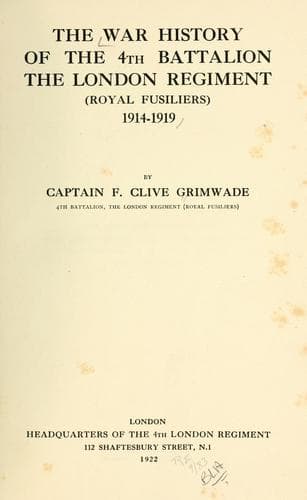
The War History of the 4th Battalion, the London Regiment (Royal Fusiliers), 1914-1919Grimwade, F. Clive
History
The War History of the 4th Battalion, the London Regiment (Royal Fusiliers), 1914-1919
Grimwade, F. Clive
Great Britain. Army. London Regiment. 4th (City of London) Battalion; World War, 1914-1918 -- Regimental histories -- Great Britain
2/Lieut. N. W. Williams was wounded at Fonquevillers on the 6th
July, and on the 18th the Battalion suffered a further great loss
in the Quartermaster, Lieut. E. S. Tomsett, who completely broke
down in health and was invalided to England. Tomsett had filled the
appointment of Quartermaster with great credit since November 1913,
and had served over thirteen years with the Battalion, his previous
service having been with the Rifle Brigade. On recovery from his
illness Tomsett was granted a combatant commission in recognition of
his services and appointed to command the depôt at Hoxton. His duties
as Quartermaster in the 1/4th Battalion were taken over by Lieut. H. B.
A. Balls.
The 10th August found the Battalion once more--and for the last
time--resuming possession of W sector, the relief of the London
Scottish being completed by 4.45 p.m. During the progress of the relief
Hébuterne was intermittently shelled and a direct hit was scored
on Battalion Headquarters, though fortunately without inflicting
casualties. A six-day tour of duty produced but little of interest
beyond the usual trench routine. Patrolling in No Man's Land was
actively pursued, and resulted in establishing definitely the energy
being displayed by the Germans in repairing their defences, and also
their acquiescence in our possession of No Man's Land, which seemed
to be undisputed. The German artillery continued to shell Hébuterne
and the Orchard, near Cross Street, a good deal, while his constant
machine-gun fire at night interfered seriously with our work of wiring
in front of W 48.
On the 12th Major-Gen. Hull presented ribands to those who had been
decorated for their work on the 1st July, the presentation being made
on the football field at Bayencourt.
A warning order had now been received that the Division was to be
relieved by the 17th Division and to withdraw for training in rear of
the line, in the St Riquier area near Abbeville.
The 168th Brigade was to concentrate at Halloy before proceeding to the
new area, and the first step in this concentration was the relief on
the 16th August of the 1/4th Londons and Rangers by the London Scottish
and Kensingtons respectively. On relief the 1/4th Londons moved to
billets in Sailly, leaving C Company at the Keep in Hébuterne for
working parties until the 18th, when the whole Battalion marched at
7 p.m. to Halloy, arriving in huts there at 11 p.m. By the 21st the
whole Brigade group was completely out of the line and the following
day moved to the new area, the Battalion entraining at Doullens at
11.40 a.m. and, detraining at St Riquier shortly before 6 p.m., marched
thence to billets at Le Plessiel.
CHAPTER XI
THE 1/4TH BATTALION IN THE BATTLES OF THE SOMME, 1916
II. _The Battles of September and October_
Public-domain text, read in full here on John Shaqi.
Reviews
Reviews
No reviews yet
Be the first to share your thoughts on this work.
Elsewhere in the archive
Join the Discussion
Join the discussion
Sign in to leave a comment or review.
Sign InorCreate an account