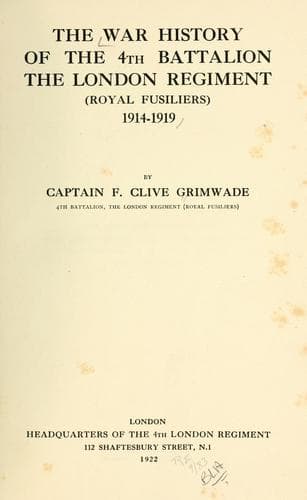
The War History of the 4th Battalion, the London Regiment (Royal Fusiliers), 1914-1919Grimwade, F. Clive
History
The War History of the 4th Battalion, the London Regiment (Royal Fusiliers), 1914-1919
Grimwade, F. Clive
Great Britain. Army. London Regiment. 4th (City of London) Battalion; World War, 1914-1918 -- Regimental histories -- Great Britain
Throughout the 7th September and far into the night the enemy
shelled Wedge Wood Valley and the support line heavily, and the
Battalion suffered a good many casualties, chiefly among ration and
water-carrying parties, while communication with Battalion Headquarters
was exceedingly difficult. The Wedge Wood-Ginchy Road which ran
immediately in front of the trench was sunken at this point, and the
bank was honeycombed with German dugouts, among them one which had been
used as an aid-post, and which produced an ample supply of bandages,
lint and field-dressings, and also cigars and tobacco--trench stores
which were promptly taken on charge by the Battalion.
The road itself was littered with German dead, the remnants of the
battle of the 3rd, who had apparently been caught by our barrage,
of the destructive nature of which evidences were everywhere to be
seen. "Unfortunately," writes an eyewitness, "the sunken road was an
attraction to countless flies in the daytime. So numerous were they
that from the road arose a continuous hum which was audible at a
considerable distance. They swarmed over into the trench and settled
on our food in such numbers that they often found their way into our
mouths at mealtimes."
During the afternoon of the 7th orders were issued for the 56th
Division to extend its front to the left by taking over the sector held
by the right Brigade of the 16th Division. This consisted of a trench
following the Leuze Wood-Guillemont Road, from near the north corner
of Leuze Wood, for about 500 yards to the left. This relief was to be
effected by "side-stepping" the 168th Brigade to the left, its trenches
in Leuze Wood being handed over to the 169th Brigade. In pursuance
of this scheme the Battalion took over with A and D Companies the
advanced front line--about 200 yards' frontage on the immediate left
of Leuze Wood--from the 7th Inniskilling Fusiliers. Immediately after
relief these companies began to dig assembly trenches for the impending
continuance of the offensive, and this task was completed before dawn
on the 8th September. The Rangers meanwhile had come up in line on the
left of the 1/4th Londons, while the Scottish on relief in Leuze Wood
by the 169th Brigade had withdrawn into Brigade support, where they
were joined by the Kensingtons.
The 8th September was occupied in improving the assembly trenches, and
in establishing an advanced report centre in a German dugout at the
south-west corner of Leuze Wood--by now corrupted by the ever-ready wit
of the Cockney into "Lousy" Wood--while under cover of darkness the
Cheshire Pioneers connected the Wood with Wedge Wood by a communication
trench. In addition a great deal of work was carried out in collecting
advanced dumps of tools, bombs, ammunition and water, in the west edge
of Leuze Wood. All this work was effected under very heavy shell fire
under which the Battalion sustained some loss.
Public-domain text, read in full here on John Shaqi.
Reviews
Reviews
No reviews yet
Be the first to share your thoughts on this work.
Elsewhere in the archive
Join the Discussion
Join the discussion
Sign in to leave a comment or review.
Sign InorCreate an account