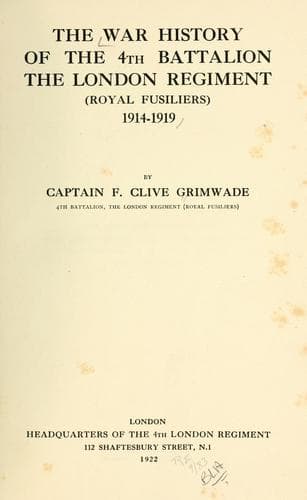
The War History of the 4th Battalion, the London Regiment (Royal Fusiliers), 1914-1919Grimwade, F. Clive
History
The War History of the 4th Battalion, the London Regiment (Royal Fusiliers), 1914-1919
Grimwade, F. Clive
Great Britain. Army. London Regiment. 4th (City of London) Battalion; World War, 1914-1918 -- Regimental histories -- Great Britain
The following day the Brigade moved forward and became attached to
the 146th Brigade of the West Riding (Territorial) Division, for
instruction in trench warfare, the 2/4th Londons being divided up
between the battalions of the 146th Brigade for this purpose, with two
companies in reserve at Bailleulmont and Humbercamp. The 146th Brigade
was at this time holding a sector south-west of Arras facing Ransart.
Ransart lies at the base of a small spur between two watercourses,
both of which are usually dry, and the German trenches in front of the
village were dominated at an average distance of about 600 yards by our
own on the western side of the valley.
This part of the front had the reputation of being exceedingly quiet
(and therefore suitable for the first tour of duty of inexperienced
troops), and was the defensive position taken up by the French in
October 1914 when, after the Battle of the Aisne, the battle front
had become stabilised by the continued extension of the flanks of the
opposing forces until they reached the sea. The British Army had taken
over the area from the French in July 1915.
After five uneventful days in this sector the Battalion was relieved on
the 14th by the 2/12th Londons, and having rendezvoused at La Cauchie,
about three miles in rear of the line, embussed to Sus-St Leger where
it went into billets for a week's rest.
* * * * *
The important changes which were to take place in this area during the
next six weeks are so material to the development of the Campaign of
1917 that it is necessary to review briefly the operations which were
being conducted further south. The termination of the battles of the
Somme in November 1916 had left the enemy in possession of the whole
of the Ancre Valley from Le Transloy to Grandcourt and of excellent
positions on the high ground immediately north of Beaumont-Hamel; while
in rear of this position he had made great progress in the construction
of two more lines of defence running in a direction from north-west to
south-east about Bapaume.
The advance of our troops over the Thiepval-Morval Ridge had, however,
left him confined in a marked salient, of which the apex was Gommecourt
Wood, between the Ancre on the south and the Scarpe where it passes
Arras on the north; and conditions appeared very favourable for
improving our situation in the neighbourhood of Beaumont-Hamel before
the conditions of winter should render active operations on a large
scale impossible. Accordingly operations which met with immediate
success were reopened on the 18th November on the left bank of the
Ancre between Grandcourt and Pys. These were renewed in January in the
Beaucourt valley on the opposite side of the river with such marked
success that the enemy was compelled to relinquish his hold on the high
ground north of Beaumont-Hamel while his position in Grandcourt became
precarious in the extreme.
Public-domain text, read in full here on John Shaqi.
Reviews
Reviews
No reviews yet
Be the first to share your thoughts on this work.
Elsewhere in the archive
Join the Discussion
Join the discussion
Sign in to leave a comment or review.
Sign InorCreate an account