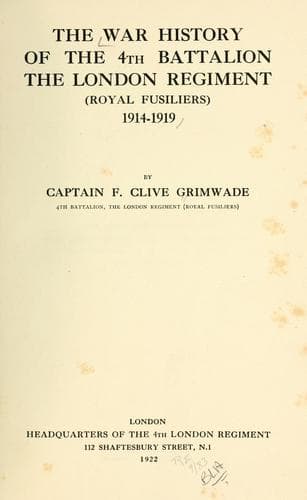
The War History of the 4th Battalion, the London Regiment (Royal Fusiliers), 1914-1919Grimwade, F. Clive
History
The War History of the 4th Battalion, the London Regiment (Royal Fusiliers), 1914-1919
Grimwade, F. Clive
Great Britain. Army. London Regiment. 4th (City of London) Battalion; World War, 1914-1918 -- Regimental histories -- Great Britain
The assault was delivered at 5.40 a.m. under cover of an intense
creeping barrage which proved to be excellent, and companies moved off
in good order in the half light close up to the barrage. The companies
were disposed as follows: on the right A Company (S. Davis) with two
platoons and Headquarters of D Company (Stark) attached; in the centre
B Company (Hetley); and on the left C Company (Hewlett) with two
platoons of D Company attached.
The principal resistance, as had been anticipated, was encountered
in the neighbourhood of Winnipeg cross-roads, and at a pillbox which
lay between them and the cemetery. This was most gallantly captured
single-handed by Pte. Bolton, A Company, who bayonetted three of the
occupants and captured the remainder consisting of an officer and three
men. A slight check at the cross-roads produced a further small bag of
prisoners, sixteen in number, of whom one was an officer. On the left
the chief opposition was encountered at a pillbox some 300 yards east
of Springfield which was holding up the advance of C Company and of
the 174th Brigade on the left. 2/Lieut. F. W. Walker, quickly grasping
the situation, outflanked the position with six men, and succeeded in
rushing it, capturing two machine-guns and twenty men who were sent
back under escort, Walker and the rest of his party at once pushing on
to the objective where touch was gained with the 174th Brigade. Within
half an hour the 2/4th Londons were established on their objective,
the consolidation of which was promptly put in hand, while the flank
brigades after a pause of half an hour pressed forward to their final
objectives in accordance with the plan of attack.
The complete success of this operation was undoubtedly due to the
careful provision which had been made in advance for the capture
of strong points by specially detailed units who thus ensured the
efficient "mopping-up" of all ground captured, while enabling the
remainder of the assaulting column to keep well up to the barrage.
Public-domain text, read in full here on John Shaqi.
Reviews
Reviews
No reviews yet
Be the first to share your thoughts on this work.
Elsewhere in the archive
Join the Discussion
Join the discussion
Sign in to leave a comment or review.
Sign InorCreate an account