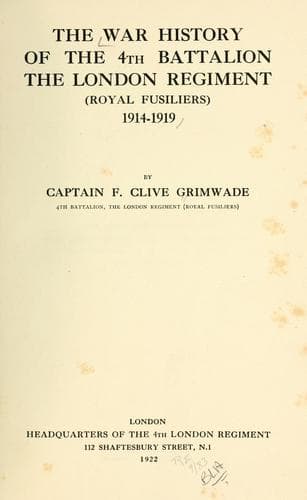
The War History of the 4th Battalion, the London Regiment (Royal Fusiliers), 1914-1919Grimwade, F. Clive
History
The War History of the 4th Battalion, the London Regiment (Royal Fusiliers), 1914-1919
Grimwade, F. Clive
Great Britain. Army. London Regiment. 4th (City of London) Battalion; World War, 1914-1918 -- Regimental histories -- Great Britain
The morning passed comparatively quietly though the duty of keeping
wicket behind the bombing blocks was a trying one, which entailed
the constant alertness of all ranks in readiness to meet a sudden
emergency. At noon, however, the enemy put down a heavy barrage on the
captured portions of the Hindenburg trenches, and this was followed at
2 p.m. by a most determined attack on the advanced blocks held by the
London Scottish. This met with considerable success, and though the
Scottish fought with gallantry they were overcome by the weight of the
enemy's onslaught, and by 2.45 p.m. the German bombers had reached the
block held by Mills (C Company), who put up a stout resistance, under
orders from his company commander to hold his post failing further
orders. In this he was helped by the company's Lewis guns, which gave
covering fire to Mills' platoon and the London Scottish, and also
engaged the enemy at the Inchy Road Factory. Three of the guns were
destroyed by the enemy's shell fire.
[Illustration: THE BATTLE OF CAMBRAI, 1917]
The trench was already uncomfortably filled with casualties in addition
to the men who were keeping up the fight, but in a few moments the
congestion was greatly increased by the numbers of Scottish troops who
began to come back and file along the trench. At about 3 p.m. about
50 of the London Scottish were seen to leave the Hindenburg support
trench in the hidden valley referred to, with the object of making
their way over the open towards the front trench. Realising that
this vacation of the trench might enable the enemy to surge forward
along it and so cut off Mills, who was still holding his own up the
communication trench, Barkworth promptly ordered Stuckey to advance and
form a block beyond the side trench held by Mills. Stuckey's losses,
however, had been severe, and with only five men at his disposal he
was unable to cope with the task in view of the great congestion of
the trench. Rather than risk the sudden cutting off of his remaining
slender resources in men and the laying open to the enemy of the whole
Tadpole Copse position, which would inevitably result, Barkworth now
decided to withdraw his advanced positions and concentrate his company,
and accordingly Stuckey was ordered to block the support trench at the
west entrance to the Quadrilateral, Mills gradually withdrawing and
holding the enemy off till the new block was completed. In this retired
position the remnants of C Company were in touch with B Company and
also with the 2nd Londons, and here the enemy was finally held up.
This gallant little defence in which C Company put up a really good
fight and inflicted considerable loss on the enemy, cost it about 40
per cent. of its strength in casualties and, as already stated, three
of its Lewis guns.
Public-domain text, read in full here on John Shaqi.
Reviews
Reviews
No reviews yet
Be the first to share your thoughts on this work.
Elsewhere in the archive
Join the Discussion
Join the discussion
Sign in to leave a comment or review.
Sign InorCreate an account