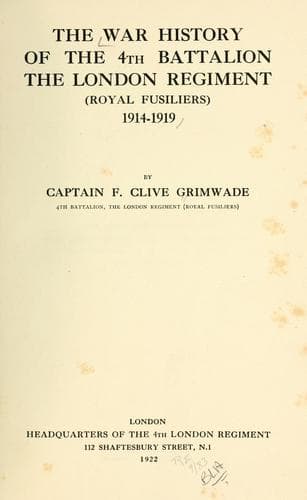
The War History of the 4th Battalion, the London Regiment (Royal Fusiliers), 1914-1919Grimwade, F. Clive
History
The War History of the 4th Battalion, the London Regiment (Royal Fusiliers), 1914-1919
Grimwade, F. Clive
Great Britain. Army. London Regiment. 4th (City of London) Battalion; World War, 1914-1918 -- Regimental histories -- Great Britain
After three months in the devastated area around Lagnicourt, where
the Battalion had been entirely removed from French civilisation,
and where scarcely any had had the opportunity of sleeping under a
proper roof, the billets allotted to the troops at Simencourt on the
3rd December were a great treat, and it was hoped that for at least
a few days the Battalion would be permitted to enjoy its well-earned
rest. On this occasion as on most others, however, the Divisional
rest proved a delusion, and after two days occupied in cleaning and
reorganisation the Battalion found itself once more on the road, for on
the 5th it marched from Simencourt at 9.30 a.m. to Wakefield Camp, near
Roclincourt (three miles north of Arras) in the First Army area.
The Division was now allotted to the XIII Corps (McCracken), which
formed the right flank of Horne's First Army and comprised in addition
to the 56th, the 31st and 62nd Divisions.
The following day Lieut.-Col. Marchment and the Works Officer (Lieut.
Lorden) reconnoitred the sector to be taken over, and on the 7th and
8th the relief of the 94th Brigade (31st Division) by the 168th Brigade
took place, the 1/4th Londons moving on the first day of relief to
Brigade support and on the second day into the left subsection of the
centre Brigade section facing Oppy, in trenches which it took over
from the 12th York and Lancaster Regiment.
The whole area had seen a great deal of heavy fighting since the
early days of the War. In May and June 1915 during Sir John French's
offensive at Festubert, the French troops had attacked Notre Dame de
Lorette, Ablain St Nazaire, La Targette and Neuville St Vaast. Early
in 1916 the Allied positions on the Vimy Ridge, by then held by the
British, had been heavily attacked by the enemy; while in the spring of
1917, in conjunction with the Third Army's operations east of Arras,
the Canadian Corps had swept over the Vimy Ridge and down the slopes
beyond towards the broad plains of Douai, carrying the line in front
of Gavrelle and Arleux-en-Gohelle. The British front line at the end
of 1917 was therefore deep in what had originally been a rear German
system of defence; trenches were numerous, but poor and in bad repair,
and the whole ground under numerous intense bombardments had been badly
"crumped."
The Battalion's sector lay between Arleux and Gavrelle and passed
through Oppy Wood, a leafless spectre of what had once been a copse,
through whose shattered trunks the remains of Oppy and Neuvireuil were
visible. The forward line was held in three posts, known from right
to left as Beatty, Wood and Oppy. Each post took a company, with one
platoon of each company in the Marquis-Earl line, a continuous trench
some four hundred yards in rear. The fourth company was held in reserve
in Bow Trench about 1700 yards back from the line of posts, while
Battalion Headquarters occupied a dugout in South Duke Street, close to
the Marquis line, which was the line of resistance.
Public-domain text, read in full here on John Shaqi.
Reviews
Reviews
No reviews yet
Be the first to share your thoughts on this work.
Elsewhere in the archive
Join the Discussion
Join the discussion
Sign in to leave a comment or review.
Sign InorCreate an account