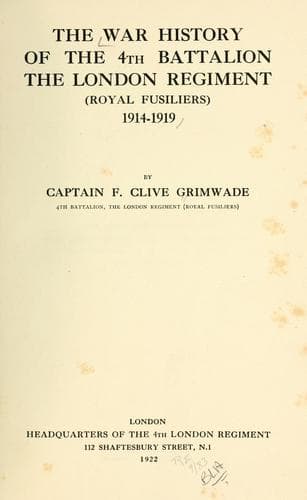
The War History of the 4th Battalion, the London Regiment (Royal Fusiliers), 1914-1919Grimwade, F. Clive
History
The War History of the 4th Battalion, the London Regiment (Royal Fusiliers), 1914-1919
Grimwade, F. Clive
Great Britain. Army. London Regiment. 4th (City of London) Battalion; World War, 1914-1918 -- Regimental histories -- Great Britain
The Battalion's work during the three weeks immediately preceding
the battle calls for little comment. After two days in Divisional
reserve it moved forward to the Battle Zone, in which it relieved the
3rd Londons on the 2nd March, and this position it continued to hold
until the offensive was launched, providing daily working parties for
the improvement of the defences. The early days of March saw a slight
increase of artillery and trench mortar activity on both sides, but the
area was still comparatively quiet with but little outward indication
of the storm which was shortly to burst over it.
On the 7th March 2/Lieut. D. F. Crawford joined the Battalion.
The skill with which the Germans continued to conceal their intentions
was indeed marvellous. For some time past the withdrawal of divisions
from the line had taken place, but so widely disseminated had this
process been that it had attracted comparatively little notice. The
attack divisions had been assembled well in rear of the lines, beyond
the reach of our prying aeroplanes, and had there been put through a
very thorough course of training, which extended to the smallest detail
of what was expected of each division. Finally, about the middle of
March this gigantic force had begun to move towards the line, marching
by night and closely concealed by day, and by the evening of the
20th the enormous concentration was complete. Von Hutier, commanding
the Eighteenth German Army, had now between the Omignon and Vendeuil
11 divisions in line, 8 in close support and 2 in reserve; Von Gayl
opposite La Fère had 4 divisions and Von Boehn at St Gobain another 2;
making a total of 27 divisions. Opposed to this colossal strength were
Butler's 5 and Maxse's 4 weak divisions. Such were the odds on the 21st
March 1918.
Public-domain text, read in full here on John Shaqi.
Reviews
Reviews
No reviews yet
Be the first to share your thoughts on this work.
Elsewhere in the archive
Join the Discussion
Join the discussion
Sign in to leave a comment or review.
Sign InorCreate an account