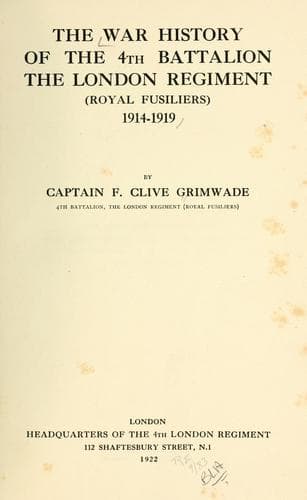
The War History of the 4th Battalion, the London Regiment (Royal Fusiliers), 1914-1919Grimwade, F. Clive
History
The War History of the 4th Battalion, the London Regiment (Royal Fusiliers), 1914-1919
Grimwade, F. Clive
Great Britain. Army. London Regiment. 4th (City of London) Battalion; World War, 1914-1918 -- Regimental histories -- Great Britain
The whole of the III Corps had now been brought south of the Oise,
and Noyon fell into the enemy's hands on the 26th. The main weight
of the German offensive continued to sweep westward in the direction
of Amiens, but with the details of this part of the fight we are not
concerned. The 58th Division, however, was not yet out of the fight,
and the enemy made repeated efforts to force a breach in the long river
line which it held, but without success. The French troops were now
numerous in this area, and though General Butler continued to command
his own Corps, the supreme command of the area was taken by the French.
In this battle the Battalion had the extraordinary experience of being
driven entirely out of the battle area. It had lost severely and borne
several days of the most terrific ordeal that it had yet been called on
to face, but with the exception of a deep indentation in its positions
at Farm Rouge on the first day there had never been any semblance of
a break-through on its front. Frequently hard pressed, often almost
surrounded, it had been forced back day after day, stubbornly fighting
but never broken.
Constituted as described above the 173rd Brigade took over the Manicamp
sector from the 175th on the evening of the 27th March, the 12th
Londons occupying the right subsector, with the Fusilier Battalion on
the left adjoining Manicamp village. The two 2/4th London Companies
were stationed on the Ailette River and in the village. The Brigade
remained in these positions strengthening the defences until the night
of 2nd/3rd April, when it was relieved by the French, the Fusilier
Battalion reaching Blérancourt at midnight. The daylight hours of the
3rd April were occupied in resting and cleaning up, and after dark
the Battalion moved to Andignicourt, where it was accommodated in an
enormous cave probably large enough to hold a brigade at full strength.
The following afternoon the route was continued and the Battalion
reached Amblèny at 8 p.m. Here the Fusilier Battalion broke up, its
component companies being once more organised as three battalions under
their respective commanders. The 12th Londons returned to their own
brigade, being replaced in the 173rd Brigade by the 16th Entrenching
Battalion (Lieut.-Col. Nicholls).
The 2/4th Londons were joined on the 3rd April by Major F. G.
Tollworthy, 1st Londons, as second in command vice Major Grover wounded.
On the 5th April another evening march was made to Dommiers, and the
next day after a very trying march the Battalion reached Villers
Cotterets at 8 p.m. Here it entrained with the remainder of the
Division for an area further north to which the III Corps had been
transferred. The total casualties sustained by the 2/4th Battalion
in the second battle of the Somme between 21st March and 3rd April
amounted to:
Public-domain text, read in full here on John Shaqi.
Reviews
Reviews
No reviews yet
Be the first to share your thoughts on this work.
Elsewhere in the archive
Join the Discussion
Join the discussion
Sign in to leave a comment or review.
Sign InorCreate an account