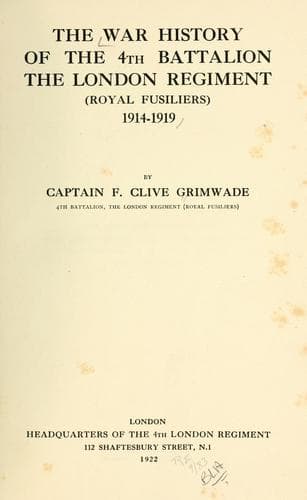
The War History of the 4th Battalion, the London Regiment (Royal Fusiliers), 1914-1919Grimwade, F. Clive
History
The War History of the 4th Battalion, the London Regiment (Royal Fusiliers), 1914-1919
Grimwade, F. Clive
Great Britain. Army. London Regiment. 4th (City of London) Battalion; World War, 1914-1918 -- Regimental histories -- Great Britain
Excellent work was also done by the Machine-Gun Section under 2/Lieuts.
Walker and Pyper, who skilfully brought their guns into action on
the left of Hampshire Farm and assisted in no small measure to keep
down the hostile rifle fire from the enemy trenches on the further
side of the valley. Their position, however, was shortly afterwards
discovered, evidently by a Taube, which continued its reconnaissance
over our lines without let or hindrance, and the section came under
heavy shell fire and was forced to fall back on the main position, with
Walker dangerously wounded, Sergt. Phillips killed, and several other
casualties.
At about 2.30 p.m. the enemy's artillery fire abated considerably, but
by that time the advance of the whole Division had been definitely
checked on an alignment generally corresponding with that occupied by
the 1/4th Londons, and reports were received that the French also had
failed to gain their objectives.
Later in the evening the French attempted to renew their offensive, but
once more were met with clouds of poison gas which definitely broke
up their attack, and a report having been received from Col. Savy,
the French Commander, that his losses were so heavy as to preclude
all further attempts, orders were received that the Brigade would
consolidate its position.
During the evening before dusk the Ferozepore Brigade was again
subjected to violent shelling, which inflicted considerable loss on all
battalions. During this later bombardment Lieut. Coffin was buried by a
high explosive shell.
After darkness fell the 1/4th Londons were withdrawn from their
advanced line to Brigade Reserve in rear of Cross Roads Farm where
they set about digging fresh trenches. The Connaughts and the Bhopals
withdrew to the line of Admirals Road near Cross Roads Farm, in which
Brigade Headquarters were now established, while the Rifles and
Baluchis took up a position to the rear.
The night passed without incident and with very little shelling, and
the opportunity was taken to collect the wounded whom it had been
impossible to evacuate under the heavy fire of the afternoon. 2/Lieut.
E. Giles, who from many volunteers was selected for this work, set a
splendid example of devotion to duty and worked hard throughout the
night in endeavouring to relieve the sufferings of his men.
The day's losses had been heavy and the gain of ground nil, but the
bearing of the Battalion under somewhat disheartening circumstances had
been worthy of the highest traditions of regular troops. Something,
however, had been achieved as, in spite of his use of poison gas, the
enemy was no nearer Ypres and our line, though strained almost to
breaking point, was still holding. It appears indeed that the gallant
front shown by the Lahore Division was successful in deceiving the
Germans as to the extent of our resources, and deterred him from
pressing the advantages he had already gained.
The casualties of the afternoon of the 27th April were in officers:
Public-domain text, read in full here on John Shaqi.
Reviews
Reviews
No reviews yet
Be the first to share your thoughts on this work.
Join the Discussion
Join the discussion
Sign in to leave a comment or review.
Sign InorCreate an account