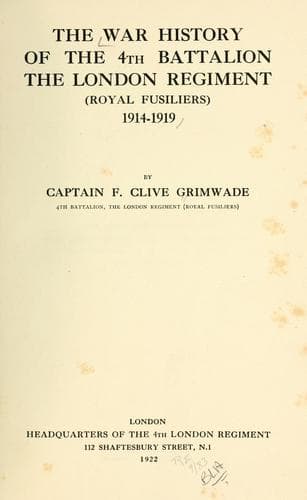
The War History of the 4th Battalion, the London Regiment (Royal Fusiliers), 1914-1919Grimwade, F. Clive
History
The War History of the 4th Battalion, the London Regiment (Royal Fusiliers), 1914-1919
Grimwade, F. Clive
Great Britain. Army. London Regiment. 4th (City of London) Battalion; World War, 1914-1918 -- Regimental histories -- Great Britain
Capt. C. R. Saunders and 2/Lieut. A. D. Coates, killed; Lieut. P.
B. K. Stedman, died of wounds; Capt. F. G. Grimwade, Lieuts.
F. A. Coffin and D. J. Leonard, and 2/Lieut. T. I. Walker,
wounded; and in N.C.O.'s and men, 32 killed (including C. S. M.
Chennels), 132 wounded, and 13 missing.
During the 28th the 1/4th Londons remained in position in rear of Cross
Roads Farm, and beyond a good deal of shelling in which gas shell was
freely used by the enemy the day passed without important incident.
Luckily the bombardment this day was not very costly to the Battalion
or, indeed, to the Brigade as a whole. The Lahore Division was
transferred from V Corps to a special counter-attack force then formed
under command of Gen. Plumer, and it was arranged that the Sirhind and
Ferozepore Brigades should be prepared to co-operate with an attack
contemplated by the French who were still on our left flank, making
such advance as might be justified by the results achieved by our
Allies. The French attack, however, did not materialise in consequence
of the very heavy losses of the preceding two days and our Allies
confined themselves to artillery action.
During the evening the enemy turned a large number of guns on to St
Jean and in a few hours the work of destruction, already far advanced,
was almost completed. In the darkness the church was clearly visible in
flames, the windows being lit up by the conflagration within: before
morning the tower had fallen, the roof had collapsed, and nothing but
smouldering ruins remained.
The 29th April found the Ferozepore Brigade still holding its trenches
and orders were again issued to it to be prepared to co-operate with
the French. But during the morning definite orders were received that
the French attack was postponed, the assault of the enemy positions
being a more formidable proposition than could be tackled by the Allied
troops in their then exhausted and numerically weak condition.
The German bombardment continued throughout the 29th, and the Battalion
remained inactive beyond the further strengthening of its trenches.
It did, however, have the satisfaction of seeing a Taube brought down
close to its lines by our anti-aircraft guns.
Before daybreak on the 30th, the Ferozepore Brigade was relieved and
marched out of the salient, the 1/4th Londons proceeding by way of
Buffs Road and La Brique to hutments at Ouderdom. While passing through
La Brique the Battalion was met by a reinforcement of about fifty
N.C.O.'s and men from the 3/4th Battalion in England, conducted by
Major E. H. Stillwell. Accompanying this draft were 2/Lieuts. L. G. Rix
and B. Rivers Smith.
The roads out of the salient were being very heavily shelled during the
relief, the cross roads at Vlamertinghe being in particular accurately
bombarded with heavy shrapnel. But Major Burnett was able to save a
great many casualties by varying the route of some platoons.
Public-domain text, read in full here on John Shaqi.
Reviews
Reviews
No reviews yet
Be the first to share your thoughts on this work.
Join the Discussion
Join the discussion
Sign in to leave a comment or review.
Sign InorCreate an account