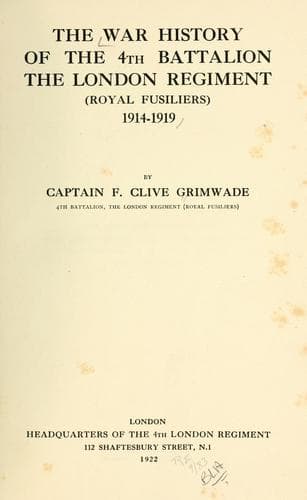
The War History of the 4th Battalion, the London Regiment (Royal Fusiliers), 1914-1919 — John Shaqi
The War History of the 4th Battalion, the London Regiment (Royal Fusiliers), 1914-1919Grimwade, F. Clive
History
The War History of the 4th Battalion, the London Regiment (Royal Fusiliers), 1914-1919
Grimwade, F. Clive
Great Britain. Army. London Regiment. 4th (City of London) Battalion; World War, 1914-1918 -- Regimental histories -- Great Britain
At 12.30 p.m. the leading waves of the two assaulting battalions moved
forward under a continued heavy shell and machine-gun fire. The ground
over which the advance was to be made was for the first 700 yards
an unenclosed plateau which afforded the enemy good observation of
our movements, and then sloping gently downwards to a somewhat more
enclosed depression rose beyond it once more towards the objective. The
objective itself was not visible from starting-point, and it appears
probable that in consequence of the very hurried preparations for the
attack, its position was not fully appreciated by all concerned and
thus it was not recognised. However this may be, it is certain that the
general direction of the attack after crossing Admirals Road became
diverted too much towards the north and thus some encroachment was
made on the frontage for which the Sirhind Brigade was responsible.
This was probably accentuated by the fact that the position selected
as starting-point lay at an acute angle to the direction of advance,
so that a change of direction was necessary during the advance
itself--always an operation of great difficulty.
As far as Admirals Road cover was non-existent. On topping the crest
of the hill the Battalion came under an exceedingly severe rifle and
machine-gun fire, and losses were consequently heavy. The succeeding
waves, however, pushed on steadily as far as the near edge of the
depression described above, in the vicinity of Hampshire Farm, when it
became clearly impossible to get down the forward slope of the valley
under the raking fire of the enemy, without incurring frightful losses.
Half the leading companies were already hit, as were also Saunders,
fatally wounded, Grimwade, Stedman, Leonard, and Coates. It was,
therefore, decided by Major Burnett to hold the line gained and there
to reorganise the Battalion pending the arrival of reinforcements, when
it might be possible to carry the line forward.
A small part of C Company under Clark and of B Company under Giles,
however, were successful in gaining the bottom of the valley, but
finding himself isolated and further advance impossible without
support, Clark, who assumed command of the composite party, took up a
position to the right of Canadian Farm, where the men dug themselves in
with their entrenching tools and hung on gallantly under a murderous
fire. Splendid service was rendered by two N.C.O.'s of this party,
Sergeant A. C. Ehren and Lance-Corporal C. Badham, both of B Company,
who passed through the barrage three times unscathed with messages
between Captain Clark and Battalion Headquarters.
Public-domain text, read in full here on John Shaqi.
Reviews
Reviews
No reviews yet
Be the first to share your thoughts on this work.
Join the Discussion
Join the discussion
Sign in to leave a comment or review.
Sign InorCreate an account