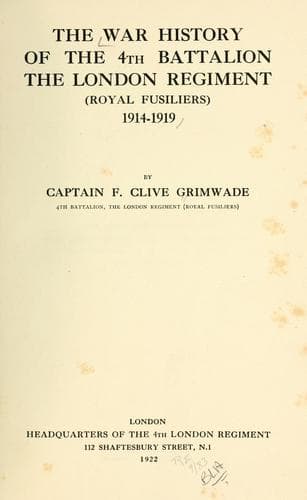
The War History of the 4th Battalion, the London Regiment (Royal Fusiliers), 1914-1919Grimwade, F. Clive
History
The War History of the 4th Battalion, the London Regiment (Royal Fusiliers), 1914-1919
Grimwade, F. Clive
Great Britain. Army. London Regiment. 4th (City of London) Battalion; World War, 1914-1918 -- Regimental histories -- Great Britain
At about 7.30 a.m. on the same morning the Ferozepore Brigade moved
from the hutments to bivouacs close by to avoid the effects of the
continuous shelling to which the concentration camp was subjected,
but returned to the huts at night. The day was spent in rest and
reorganisation. The Battalion was undoubtedly a little shaken after its
rough handling and very seriously reduced in strength. Over 600 rifles
had left Ouderdom on the morning of the 26th, but at the roll call
which took place on return on the 30th only 235 names were answered,
apart from the newly arrived draft which had not been in action.
[Illustration: _St Jean Village in April 1920_]
The following awards were made for services rendered:
Capt. W. G. Clark, D.S.O.; Sergt. A. C. Ehren, D.C.M.; L/Corpl.
Colomb, D.C.M.; Corpl. Fulford, Médaille Militaire de France.
In this, its first serious action, the 1/4th Battalion had firmly
established its reputation by its remarkable steadiness under
unprecedented circumstances, and, though the price paid was heavy, it
had the satisfaction of having contributed materially to the undying
glory of the British defence of Ypres.
At 7.45 p.m. on the 1st May, the concentration of the Division being
now complete, the Ferozepore Brigade marched from Ouderdom _via_
Reninghelst, Westoutre, to Meteren, arriving there at 12.30 a.m. on
the 2nd. A rest was made here until the afternoon when the route was
resumed, Doulieu being reached about 10 p.m. The march was completed
the following evening, when at about 7 p.m. the Brigade returned to its
former billets in the Paradis area.
CHAPTER V
OPERATIONS DURING THE SUMMER OF 1915
In spite of the severe tax placed on his resources by the
ever-increasing weight of the enemy's assaults at Ypres, and the
consequent difficulty of finding sufficient reserves of men and
material to embark on a new attack on a large scale, Sir John French
decided early in May to adopt the bold course of launching a fresh
offensive at the southern extremity of the British front. He was led
to this resolve partly by the hope of diverting the enemy's attention
towards the south and thereby easing the pressure against Ypres,
and partly by the desire to assist the French who were launching an
offensive south of the La Bassée Canal.
The ultimate objective of this new undertaking was the opening of
the road to Lille, and the necessary preliminary to this was the
expulsion of the enemy from his defences on the Aubers Ridge and the
establishment of the British troops on the La Bassée-Lille Road.
This attack was entrusted to the First Army, whose operations were
divided into two separate zones. In the north the assault was to be
made by the IV Corps at Rouges Bancs with the object of turning the
Aubers defences from that flank; while farther south the I and Indian
Corps were to secure the line Ligny-le-Grand--La Clicqueterie Farm.
Public-domain text, read in full here on John Shaqi.
Reviews
Reviews
No reviews yet
Be the first to share your thoughts on this work.
Join the Discussion
Join the discussion
Sign in to leave a comment or review.
Sign InorCreate an account