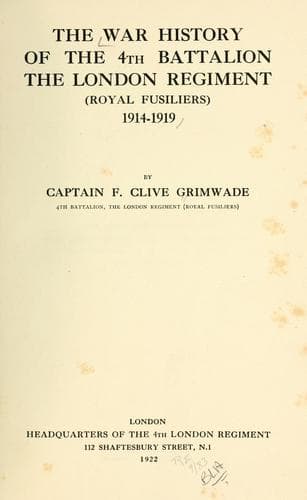
The War History of the 4th Battalion, the London Regiment (Royal Fusiliers), 1914-1919Grimwade, F. Clive
History
The War History of the 4th Battalion, the London Regiment (Royal Fusiliers), 1914-1919
Grimwade, F. Clive
Great Britain. Army. London Regiment. 4th (City of London) Battalion; World War, 1914-1918 -- Regimental histories -- Great Britain
During the whole of the 9th, 10th and 11th May the 1/4th London
remained in these trenches under continual heavy shell fire: though
owing to the lack of success with which the main operation had met it
was not called upon to advance.
On the evening of the 11th it was withdrawn with the rest of the
Brigade to billets at Riez Bailleul. On return to billets great
discomfort was caused to all ranks by the discovery that the billet
in which the packs had been deposited during the three days spent in
trenches had been burnt to the ground, involving the total destruction
of its contents together with a mail from home. The following day the
Indian Corps Commander (Sir James Willcocks) visited the Battalion and
expressed his deep appreciation of its conduct at Ypres.
The 12th May dawned dull and misty and artillery observation was
exceedingly difficult; and for this and other causes the renewal of
the attack was again postponed until the 15th. The Meerut Division was
again responsible for the Indian Corps attack. The Lahore Division
adopted a role similar to that which it had played on the 9th, and the
Ferozepore Brigade moved forward once more on the evening of the 15th
May to its former assembly positions about Sign Post Lane.
In order to endeavour to secure the surprise effect which had been
lacking on the 9th it was decided this time to deliver the attack at
night, and after a preliminary bombardment the assaulting columns
dashed forward at 11.30 p.m. on the 15th. On the right of the attack
in the region of Festubert and La Quinque Rue considerable success was
achieved by the 7th Division, and some advance was also made by the 2nd
Division which was operating on the immediate right of the Indians.
The Meerut Division, however, was again faced with a hail of lead from
the enemy lines under which it was impossible to live, and though the
troops did all that men could do, by 4 a.m. on the 16th, after two
gallant efforts, the attempts of the Indians to advance were definitely
checked and the remains of the assaulting columns were once more back
in their original trenches.
From this date onwards operations were confined to the southern area
in the neighbourhood of Festubert, and though the battle continued to
rage until the 25th May, the Indian Corps was no longer concerned in
it beyond the preparations necessary to enable it to conform to the
advance on its right flank.
During the early part of the month the 1/4th Londons received further
officer reinforcements as follows:
Capt. A. A. N. Haine.
Lieut. S. G. Monk.
Lieut. D. C. Cooke.
2/Lieut. J. S. B. Gathergood.
The Battalion remained in its shallow trenches until the 18th May under
less favourable conditions of weather than previously, and the exposure
caused a large number of casualties through sickness, including Lieuts.
Rivers, Smith and Cooke, and 2/Lieut. Gathergood, who were evacuated to
hospital.
Public-domain text, read in full here on John Shaqi.
Reviews
Reviews
No reviews yet
Be the first to share your thoughts on this work.
Join the Discussion
Join the discussion
Sign in to leave a comment or review.
Sign InorCreate an account