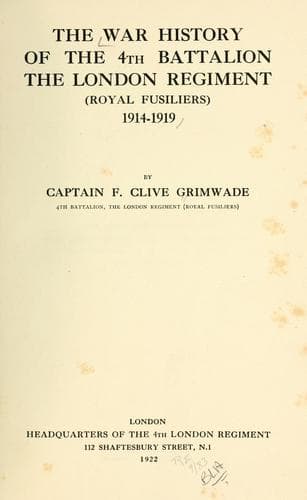
The War History of the 4th Battalion, the London Regiment (Royal Fusiliers), 1914-1919Grimwade, F. Clive
History
The War History of the 4th Battalion, the London Regiment (Royal Fusiliers), 1914-1919
Grimwade, F. Clive
Great Britain. Army. London Regiment. 4th (City of London) Battalion; World War, 1914-1918 -- Regimental histories -- Great Britain
On the evening of the 18th May the Ferozepore Brigade took over the
front line from the Jullundur Brigade, the 1/4th Londons relieving the
4th Suffolks on the right, between the La Bassée Road and Oxford Road,
the subsection including Port Arthur Keep where Battalion Headquarters
were established. This tour of duty was uneventful and the troops were
occupied principally in repairing the damage done to the entanglements
and defences by the enemy's shell fire during the days of the battle.
A certain amount of shell fire was, however, experienced causing a few
casualties, including Captain Haine, who was hit on the 22nd. The enemy
also paid a good deal of attention to the back areas and the regimental
transport now established at Rouge Croix was heavily shelled on the
25th, and again on the 26th, with such severity that it was compelled
to change position to Riez Bailleul.
During this period also the issue of gas masks to all ranks was
completed.
On the 30th the Sirhind Brigade, which had been in divisional reserve
during the battle, came forward and took over the line from the
Ferozepore Brigade, the 1/4th Londons handing over their trenches to
the 1st Manchesters and withdrawing to billets at Riez Bailleul.
After the end of May no further attempt was made on the Indian Corps
front to conduct operations on a large scale. The difficulties
under which the Indian battalions were labouring in the supply
of reinforcements to replace casualties were extreme. The Indian
concentration camp at Marseilles was continually receiving
reinforcements from India, but of these an increasing proportion was
found to be unfit for despatch to the front, and as the summer wore
on the native regiments of the Corps gradually ebbed in numbers until
amalgamations began to be effected to maintain units at anything
approaching war strength. In these circumstances offensive operations
against so strongly defended a position as the Aubers Ridge were out
of the question, especially having regard to the continued shortage
in the supply of shells. At the same time the general situation did
not permit of the Indian Corps being entirely withdrawn from the line
for a prolonged rest and reorganisation. The story of the next three
months is, therefore, one of unceasing hard work in and out of the
line without any of those opportunities of distinction which are as
necessary to the well-being of a battalion--and especially a native
battalion--as a regular supply of rations.
Public-domain text, read in full here on John Shaqi.
Reviews
Reviews
No reviews yet
Be the first to share your thoughts on this work.
Elsewhere in the archive
Join the Discussion
Join the discussion
Sign in to leave a comment or review.
Sign InorCreate an account