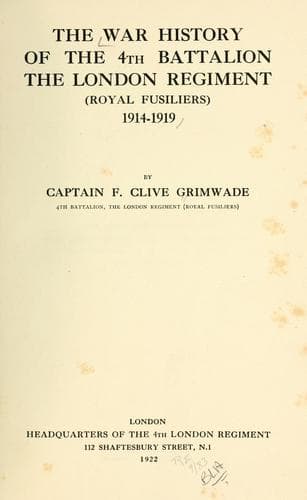
The War History of the 4th Battalion, the London Regiment (Royal Fusiliers), 1914-1919Grimwade, F. Clive
History
The War History of the 4th Battalion, the London Regiment (Royal Fusiliers), 1914-1919
Grimwade, F. Clive
Great Britain. Army. London Regiment. 4th (City of London) Battalion; World War, 1914-1918 -- Regimental histories -- Great Britain
An extraordinary incident occurred during the last week of June, which
seems worth recording. One night a patrol of the 129th Baluchis left
the British lines to investigate the condition of the enemy's wire.
On its return one man, Ayub Khan, was missing and all endeavours to
recover his body were fruitless. The following evening Ayub turned up
again, and being taken before his company commander related how he had
entered the German trenches and passed himself off as a deserter. As is
well known the Germans were always anxious to secure the defection of
the native troops, and Ayub Khan's arrival was therefore hailed with
enthusiasm. He was taken to the rear and examined carefully. Having
kept his eyes open and seen all he could, Ayub Khan persuaded the
Germans to let him return to our trenches in order to bring more of
his friends over. In a weak moment the Germans agreed to let him go;
but instead of greeting Ayub and his party of fellow-deserters, they
were faced a few days later with a notice board which was displayed on
our parapet commenting on the incident in suitable terms. Not being
a humourist, the Hun lost his temper, and it is at this point in the
story that the 1/4th Londons become concerned. The luckless notice
board was displayed on Crescent Trench then occupied by D Company.
At 8.30 a.m. on the 27th June the enemy opened on the board with 5.9
howitzers, and almost the first shell hit Capt. Cart de Lafontaine's
Headquarters, causing him a severe attack of shell-shock and killing
his subaltern 2/Lieut. F. F. Hunt. All the morning the "hate" was
continued with great loss to D Company, and by midday the Crescent
Trench was practically obliterated. Company Sergt.-Major Risley showed
great coolness in controlling his men and withdrawing them as far as
was practicable out of the zone of fire, and set an excellent example
of steadiness under a most trying ordeal. He was subsequently awarded
the D.C.M.
On the 16th June Major L. T. Burnett, who had been in temporary command
of the 1/4th Londons since the 26th April, was promoted Lieut.-Colonel
and appointed to command, Major G. H. M. Vine assuming the duties of
second in command.
At the beginning of September, however, the Battalion was exceedingly
unfortunate in losing Major Vine, who was sent to hospital with eye
trouble, and Lieut.-Col. Burnett being on leave at the time the command
of the Battalion was assumed until his return by Lieut.-Col. Murray of
the 89th Punjabis.
Early in August Capt. and Adjt. G. B. Scott also said farewell to
the Battalion on taking up an extra-regimental employment, and the
Adjutancy was given to Capt. W. G. Clark, D.S.O., and subsequently to
Capt. E. Giles.
The following officers joined during August and September:
Lieuts. R. V. Gery, D. J. Leonard, C. Gaskin.
Public-domain text, read in full here on John Shaqi.
Reviews
Reviews
No reviews yet
Be the first to share your thoughts on this work.
Elsewhere in the archive
Join the Discussion
Join the discussion
Sign in to leave a comment or review.
Sign InorCreate an account