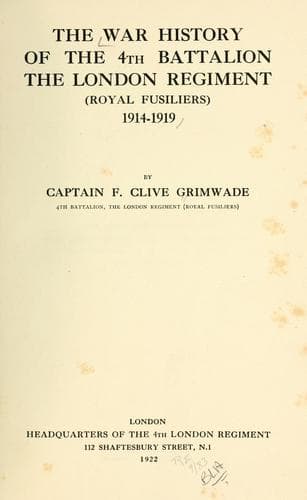
The War History of the 4th Battalion, the London Regiment (Royal Fusiliers), 1914-1919Grimwade, F. Clive
History
The War History of the 4th Battalion, the London Regiment (Royal Fusiliers), 1914-1919
Grimwade, F. Clive
Great Britain. Army. London Regiment. 4th (City of London) Battalion; World War, 1914-1918 -- Regimental histories -- Great Britain
their moral superiority over the enemy which might otherwise have
become seriously impaired through their knowledge of the inequality of
our strength in artillery.
The enemy's activity during this summer was for the most part confined
to artillery fire which at times attained serious proportions and
inflicted severe loss; indeed throughout the period under review the
toll of casualties was steady and continuous.
Out of the trenches the 1/4th Londons withdrew to reserve billets
either at Pont du Hem, L'Epinette, or La Fosse, and while in reserve
were invariably called upon for working parties in the forward area,
so that the opportunities available for training and repairing the
damage inevitably caused to parade discipline by long-continued
trench life were almost entirely wanting. At this period, moreover,
"back-of-the-line" organisation had not reached the high pitch attained
in later years. Baths were an infrequent luxury, concert parties--of
an organised type--unheard of, recreational training still without its
proper recognition. Such infrequent rests as were granted to the troops
were thus of comparatively small recuperative value.
But in spite of these numerous difficulties the Battalion was steadily
increasing its military efficiency and its morale throughout the summer
was high.
[Illustration: _Rouge Croix, La Bassée Road_]
[Illustration: _The Doll's House, La Bassée Road_]
One of the most unpleasant tours of duty was at Min House Farm, already
alluded to, a sector on the left of Neuve Chapelle, facing Mauquissart,
which the Battalion took over for a week in July as a temporary measure
during a readjustment of Brigade boundaries. The breastworks here were
especially weak and very much overlooked from the Aubers Ridge. Wire
was embryonic and communication trenches poor. Moreover, the area
appeared to be the subject of particular hatred on the part of the
Bosche, who shelled it frequently and heavily. Min House (or Moated
Grange) Farm, where Headquarters were established, was perched on the
crest of a little knoll which afforded the Headquarters staff a good
view over the sector, but, probably for this very reason, the Hun
objected to it. In fact before the tour of duty came to an end the farm
was totally destroyed by shell fire and Battalion Headquarters had been
forced to make a hasty exit to Ebenezer Farm, which, being outside the
sector and unprovided with signal communications, was not ideal for the
purpose of a Headquarters.
Public-domain text, read in full here on John Shaqi.
Reviews
Reviews
No reviews yet
Be the first to share your thoughts on this work.
Elsewhere in the archive
Join the Discussion
Join the discussion
Sign in to leave a comment or review.
Sign InorCreate an account