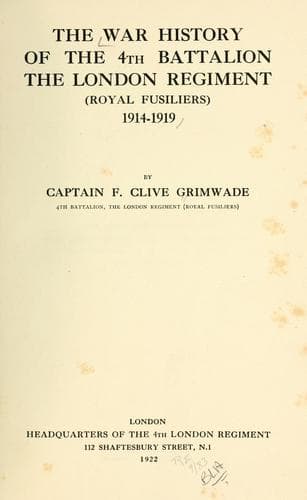
The War History of the 4th Battalion, the London Regiment (Royal Fusiliers), 1914-1919Grimwade, F. Clive
History
The War History of the 4th Battalion, the London Regiment (Royal Fusiliers), 1914-1919
Grimwade, F. Clive
Great Britain. Army. London Regiment. 4th (City of London) Battalion; World War, 1914-1918 -- Regimental histories -- Great Britain
In spite of the great strategic importance of the Oases it was found
impossible at the moment to undertake active operations, and the
activities of the Minia Force were therefore confined to defensive
measures. The whole Nile Valley at this time was infected by powerful
religious and political influences which were at work to endeavour to
induce the native population to co-operate with the enemy against the
British, and although these influences had not attained the success
hoped for by their instigators, they had taken a certain hold on all
classes of the civilian population. It was, therefore, extremely
important to counterbalance this smouldering agitation by the presence
of strong military forces in provincial stations, primarily to prevent
the occurrence of disturbances which might be fomented in the absence
of troops, and to safeguard points of military importance, such as
railway stations, bridges and canals. The natives of Egypt, though
not of warlike character, are capable of violent fanatical outbursts,
and the continued presence of the military, combined with frequent
displays of their force, was the best means of preventing altogether
disturbances which might assume very serious proportions.
* * * * *
Such was briefly the position of affairs at the period of the 2/4th
Londons' attachment to the Minia Force, but shortly after their arrival
a distinct improvement in the outlook was caused by the dispersal of
the Senussi forces in the battle of Agagia on the 26th February 1916.
This time it was possible to exploit the success, and the desert column
pushed forward to Sollum which was occupied on the 14th March. The
effect of this signal success on British prestige throughout Egypt was
marked, and this effect was enhanced by the continued failure of the
Turks to make any impression in the East on the Suez Canal defences.
The Senussi forces were now practically disposed of, only about 3000
remaining in the field, and this remnant appeared to be disheartened,
while the reputation of their commander, Sayed Ahmed, both as a
temporal leader and a spiritual guide, had waned.
The danger, however, was by no means past, and the occupation by the
Senussi of the Baharia Oasis, which followed soon after the battle of
Agagia, created a serious menace to the part of the Nile Valley for
which the Minia Force was responsible.
Public-domain text, read in full here on John Shaqi.
Reviews
Reviews
No reviews yet
Be the first to share your thoughts on this work.
Elsewhere in the archive
Join the Discussion
Join the discussion
Sign in to leave a comment or review.
Sign InorCreate an account