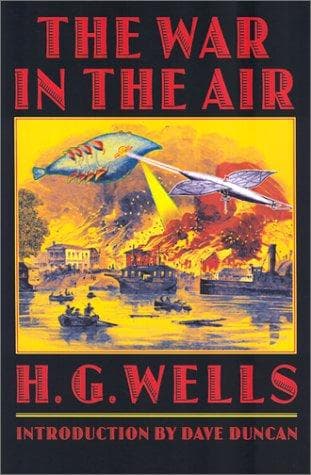
Air warfare -- Fiction; Science fiction; War stories
The days when the emotional infantryman decided battles had passed by
for ever. War had become a matter of apparatus of special training
and skill of the most intricate kind. It had become undemocratic. And
whatever the value of the popular excitement, there can be no denying
that the small regular establishment of the United States Government,
confronted by this totally unexpected emergency of an armed invasion
from Europe, acted with vigour, science, and imagination. They were
taken by surprise so far as the diplomatic situation was concerned,
and their equipment for building either navigables or aeroplanes was
contemptible in comparison with the huge German parks. Still they set to
work at once to prove to the world that the spirit that had created the
Monitor and the Southern submarines of 1864 was not dead. The chief of
the aeronautic establishment near West Point was Cabot Sinclair, and
he allowed himself but one single moment of the posturing that was so
universal in that democratic time. “We have chosen our epitaphs,”
he said to a reporter, “and we are going to have, 'They did all they
could.' Now run away!”
The curious thing is that they did all do all they could; there is no
exception known. Their only defect indeed was a defect of style. One of
the most striking facts historically about this war, and the one that
makes the complete separation that had arisen between the methods
of warfare and the necessity of democratic support, is the effectual
secrecy of the Washington authorities about their airships. They did
not bother to confide a single fact of their preparations to the public.
They did not even condescend to talk to Congress. They burked and
suppressed every inquiry. The war was fought by the President and the
Secretaries of State in an entirely autocratic manner. Such publicity as
they sought was merely to anticipate and prevent inconvenient agitation
to defend particular points. They realised that the chief danger in
aerial warfare from an excitable and intelligent public would be a
clamour for local airships and aeroplanes to defend local interests.
This, with such resources as they possessed, might lead to a fatal
division and distribution of the national forces. Particularly they
feared that they might be forced into a premature action to defend
New York. They realised with prophetic insight that this would be the
particular advantage the Germans would seek. So they took great pains
to direct the popular mind towards defensive artillery, and to divert it
from any thought of aerial battle. Their real preparations they masked
beneath ostensible ones. There was at Washington a large reserve of
naval guns, and these were distributed rapidly, conspicuously, and with
much press attention, among the Eastern cities. They were mounted for
the most part upon hills and prominent crests around the threatened
centres of population. They were mounted upon rough adaptations of the
Public-domain text, read in full here on John Shaqi.
Reviews
Reviews
No reviews yet
Be the first to share your thoughts on this work.
Elsewhere in the archive
Join the Discussion
Join the discussion
Sign in to leave a comment or review.
Sign InorCreate an account