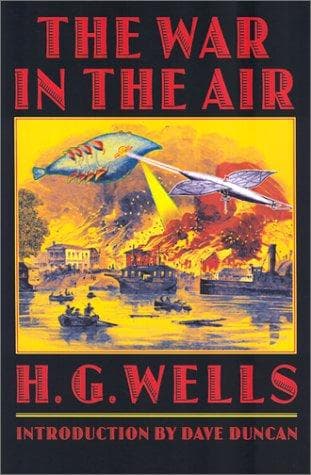
Air warfare -- Fiction; Science fiction; War stories
It was so great, and in its collective effect so pacifically
magnificent, that to make war upon it seemed incongruous beyond measure,
like laying siege to the National Gallery or attacking respectable
people in an hotel dining-room with battle-axe and mail. It was in its
entirety so large, so complex, so delicately immense, that to bring it
to the issue of warfare was like driving a crowbar into the mechanism
of a clock. And the fish-like shoal of great airships hovering light
and sunlit above, filling the sky, seemed equally remote from the ugly
forcefulness of war. To Kurt, to Smallways, to I know not how many more
of the people in the air-fleet came the distinctest apprehension of
these incompatibilities. But in the head of the Prince Karl Albert were
the vapours of romance: he was a conqueror, and this was the enemy's
city. The greater the city, the greater the triumph. No doubt he had a
time of tremendous exultation and sensed beyond all precedent the sense
of power that night.
There came an end at last to that pause. Some wireless communications
had failed of a satisfactory ending, and fleet and city remembered they
were hostile powers. “Look!” cried the multitude; “look!”
“What are they doing?”
“What?”... Down through the twilight sank five attacking airships, one
to the Navy Yard on East River, one to City Hall, two over the great
business buildings of Wall Street and Lower Broadway, one to the
Brooklyn Bridge, dropping from among their fellows through the danger
zone from the distant guns smoothly and rapidly to a safe proximity to
the city masses. At that descent all the cars in the streets stopped
with dramatic suddenness, and all the lights that had been coming on in
the streets and houses went out again. For the City Hall had awakened
and was conferring by telephone with the Federal command and taking
measures for defence. The City Hall was asking for airships, refusing to
surrender as Washington advised, and developing into a centre of intense
emotion, of hectic activity. Everywhere and hastily the police began to
clear the assembled crowds. “Go to your homes,” they said; and the word
was passed from mouth to mouth, “There's going to be trouble.” A chill
of apprehension ran through the city, and men hurrying in the unwonted
darkness across City Hall Park and Union Square came upon the dim forms
of soldiers and guns, and were challenged and sent back. In half an
hour New York had passed from serene sunset and gaping admiration to a
troubled and threatening twilight.
Public-domain text, read in full here on John Shaqi.
Reviews
Reviews
No reviews yet
Be the first to share your thoughts on this work.
Elsewhere in the archive
Join the Discussion
Join the discussion
Sign in to leave a comment or review.
Sign InorCreate an account