Air warfare -- Fiction; Science fiction; War stories
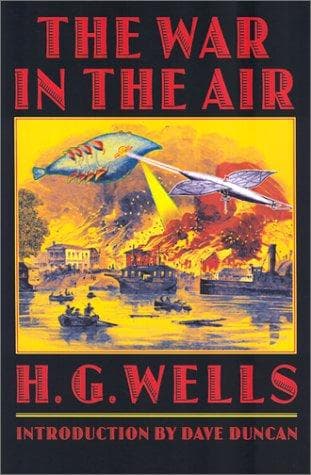
The German airship was fish-shaped, with a blunted head; the Asiatic
airship was also fish-shaped, but not so much on the lines of a cod or
goby as of a ray or sole. It had a wide, flat underside, unbroken by
windows or any opening except along the middle line. Its cabins occupied
its axis, with a sort of bridge deck above, and the gas-chambers gave
the whole affair the shape of a gipsy's hooped tent, except that it was
much flatter. The German airship was essentially a navigable balloon
very much lighter than air; the Asiatic airship was very little lighter
than air and skimmed through it with much greater velocity if with
considerably less stability. They carried fore and aft guns, the latter
much the larger, throwing inflammatory shells, and in addition they had
nests for riflemen on both the upper and the under side. Light as this
armament was in comparison with the smallest gunboat that ever sailed,
it was sufficient for them to outfight as well as outfly the German
monster airships. In action they flew to get behind or over the Germans:
they even dashed underneath, avoiding only passing immediately beneath
the magazine, and then as soon as they had crossed let fly with their
rear gun, and sent flares or oxygen shells into the antagonist's
gas-chambers.
It was not in their airships, but, as I have said, in their
flying-machines proper, that the strength of the Asiatics lay. Next
only to the Butteridge machine, these were certainly the most efficient
heavier-than-air fliers that had ever appeared. They were the invention
of a Japanese artist, and they differed in type extremely from the
box-kite quality of the German drachenflieger. They had curiously
curved, flexible side wings, more like _bent_ butterfly's wings than
anything else, and made of a substance like celluloid and of brightly
painted silk, and they had a long humming-bird tail. At the forward
corner of the wings were hooks, rather like the claws of a bat, by which
the machine could catch and hang and tear at the walls of an airship's
gas-chamber. The solitary rider sat between the wings above a transverse
explosive engine, an explosive engine that differed in no essential
particular from those in use in the light motor bicycles of the period.
Below was a single large wheel. The rider sat astride of a saddle, as in
the Butteridge machine, and he carried a large double-edged two-handed
sword, in addition to his explosive-bullet firing rifle.
3
One sets down these particulars and compares the points of the American
and German pattern of aeroplane and navigable, but none of these facts
were clearly known to any of those who fought in this monstrously
confused battle above the American great lakes.
Public-domain text, read in full here on John Shaqi.
Reviews
Reviews
No reviews yet
Be the first to share your thoughts on this work.
Elsewhere in the archive
Join the Discussion
Join the discussion
Sign in to leave a comment or review.
Sign InorCreate an account