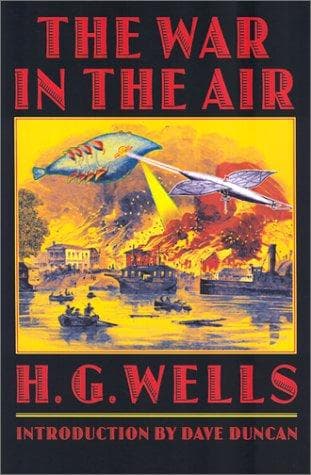
Air warfare -- Fiction; Science fiction; War stories
Niagara city was still largely standing then, albeit its streets were
empty of all life. Its bridges were intact; its hotels and restaurants
still flying flags and inviting sky signs; its power-stations running.
But about it the country on both sides of the gorge might have been
swept by a colossal broom. Everything that could possibly give cover
to an attack upon the German position at Niagara had been levelled as
ruthlessly as machinery and explosives could contrive; houses blown up
and burnt, woods burnt, fences and crops destroyed. The mono-rails had
been torn up, and the roads in particular cleared of all possibility of
concealment or shelter. Seen from above, the effect of this wreckage was
grotesque. Young woods had been destroyed whole-sale by dragging wires,
and the spoilt saplings, smashed or uprooted, lay in swathes like corn
after the sickle. Houses had an appearance of being flattened down by
the pressure of a gigantic finger. Much burning was still going on, and
large areas had been reduced to patches of smouldering and sometimes
still glowing blackness.
Here and there lay the debris of belated fugitives, carts, and dead
bodies of horses and men; and where houses had had water-supplies there
were pools of water and running springs from the ruptured pipes. In
unscorched fields horses and cattle still fed peacefully. Beyond this
desolated area the countryside was still standing, but almost all the
people had fled. Buffalo was on fire to an enormous extent, and there
were no signs of any efforts to grapple with the flames. Niagara city
itself was being rapidly converted to the needs of a military depot.
A large number of skilled engineers had already been brought from the
fleet and were busily at work adapting the exterior industrial apparatus
of the place to the purposes of an aeronautic park. They had made a
gas recharging station at the corner of the American Fall above the
funicular railway, and they were, opening up a much larger area to
the south for the same purpose. Over the power-houses and hotels and
suchlike prominent or important points the German flag was flying.
The Zeppelin circled slowly over this scene twice while the Prince
surveyed it from the swinging gallery; it then rose towards the centre
of the crescent and transferred the Prince and his suite, Kurt included,
to the Hohenzollern, which had been chosen as the flagship during the
impending battle. They were swung up on a small cable from the forward
gallery, and the men of the Zeppelin manned the outer netting as the
Prince and his staff left them. The Zeppelin then came about, circled
down and grounded in Prospect Park, in order to land the wounded and
take aboard explosives; for she had come to Labrador with her magazines
empty, it being uncertain what weight she might need to carry. She
also replenished the hydrogen in one of her forward chambers which had
leaked.
Public-domain text, read in full here on John Shaqi.
Reviews
Reviews
No reviews yet
Be the first to share your thoughts on this work.
Elsewhere in the archive
Join the Discussion
Join the discussion
Sign in to leave a comment or review.
Sign InorCreate an account