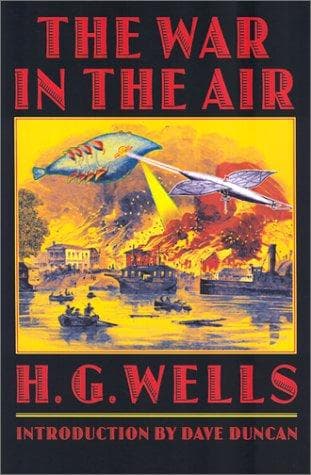
Air warfare -- Fiction; Science fiction; War stories
They spoke of fire and massacre, of cruelties and counter cruelties, of
things that had been done to harmless Asiatics by race-mad men, of the
wholesale burning and smashing up of towns, railway junctions, bridges,
of whole populations in hiding and exodus. “Every ship they've got is in
the Pacific,” he heard one man exclaim. “Since the fighting began they
can't have landed on the Pacific slope less than a million men. They've
come to stay in these States, and they will--living or dead.”
Slowly, broadly, invincibly, there grew upon Bert's mind realisation
of the immense tragedy of humanity into which his life was flowing;
the appalling and universal nature of the epoch that had arrived; the
conception of an end to security and order and habit. The whole world
was at war and it could not get back to peace, it might never recover
peace.
He had thought the things he had seen had been exceptional, conclusive
things, that the besieging of New York and the battle of the Atlantic
were epoch-making events between long years of security. And they had
been but the first warning impacts of universal cataclysm. Each day
destruction and hate and disaster grew, the fissures widened between
man and man, new regions of the fabric of civilisation crumbled and gave
way. Below, the armies grew and the people perished; above, the airships
and aeroplanes fought and fled, raining destruction.
It is difficult perhaps for the broad-minded and long-perspectived
reader to understand how incredible the breaking down of the scientific
civilisation seemed to those who actually lived at this time, who in
their own persons went down in that debacle. Progress had marched as it
seemed invincible about the earth, never now to rest again. For three
hundred years and more the long steadily accelerated diastole of
Europeanised civilisation had been in progress: towns had been
multiplying, populations increasing, values rising, new countries
developing; thought, literature, knowledge unfolding and spreading. It
seemed but a part of the process that every year the instruments of war
were vaster and more powerful, and that armies and explosives outgrew
all other growing things....
Three hundred years of diastole, and then came the swift and unexpected
systole, like the closing of a fist. They could not understand it was
systole.
They could not think of it as anything but a jolt, a hitch, a mere
oscillatory indication of the swiftness of their progress. Collapse,
though it happened all about them, remained incredible. Presently some
falling mass smote them down, or the ground opened beneath their feet.
They died incredulous....
Public-domain text, read in full here on John Shaqi.
Reviews
Reviews
No reviews yet
Be the first to share your thoughts on this work.
Elsewhere in the archive
Join the Discussion
Join the discussion
Sign in to leave a comment or review.
Sign InorCreate an account