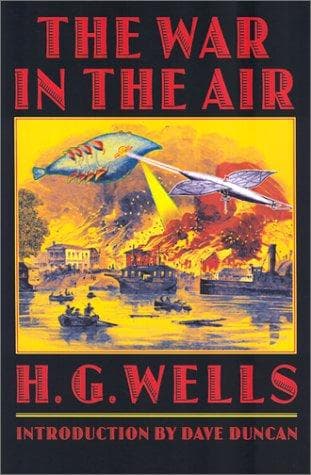
Air warfare -- Fiction; Science fiction; War stories
And as the credit system, that had been the living fortress of the
scientific civilisation, reeled and fell upon the millions it had
held together in economic relationship, as these people, perplexed and
helpless, faced this marvel of credit utterly destroyed, the airships
of Asia, countless and relentless, poured across the heavens, swooped
eastward to America and westward to Europe. The page of history
becomes a long crescendo of battle. The main body of the British-Indian
air-fleet perished upon a pyre of blazing antagonists in Burmah; the
Germans were scattered in the great battle of the Carpathians; the vast
peninsula of India burst into insurrection and civil war from end to
end, and from Gobi to Morocco rose the standards of the “Jehad.”
For some weeks of warfare and destruction it seemed as though the
Confederation of Eastern Asia must needs conquer the world, and then
the jerry-built “modern” civilisation of China too gave way under
the strain. The teeming and peaceful population of China had been
“westernised” during the opening years of the twentieth century with
the deepest resentment and reluctance; they had been dragooned and
disciplined under Japanese and European influence into an acquiescence
with sanitary methods, police controls, military service, and wholesale
process of exploitation against which their whole tradition rebelled.
Under the stresses of the war their endurance reached the breaking
point, the whole of China rose in incoherent revolt, and the practical
destruction of the central government at Pekin by a handful of British
and German airships that had escaped from the main battles rendered that
revolt invincible. In Yokohama appeared barricades, the black flag and
the social revolution. With that the whole world became a welter of
conflict.
So that a universal social collapse followed, as it were a logical
consequence, upon world-wide war. Wherever there were great populations,
great masses of people found themselves without work, without money,
and unable to get food. Famine was in every working-class quarter in
the world within three weeks of the beginning of the war. Within a
month there was not a city anywhere in which the ordinary law and social
procedure had not been replaced by some form of emergency control, in
which firearms and military executions were not being used to keep
order and prevent violence. And still in the poorer quarters, and in the
populous districts, and even here and there already among those who had
been wealthy, famine spread.
3
Public-domain text, read in full here on John Shaqi.
Reviews
Reviews
No reviews yet
Be the first to share your thoughts on this work.
Elsewhere in the archive
Join the Discussion
Join the discussion
Sign in to leave a comment or review.
Sign InorCreate an account