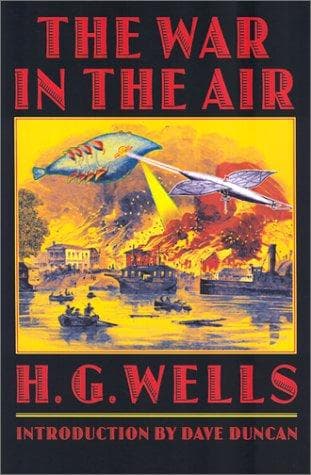
Air warfare -- Fiction; Science fiction; War stories
That is the end of this story so far as Bert Smallways is concerned.
We leave him with his Edna to become squatters among the clay and oak
thickets of the Weald, far away from the stream of events. From that
time forth life became a succession of peasant encounters, an affair of
pigs and hens and small needs and little economies and children, until
Clapham and Bun Hill and all the life of the Scientific Age became to
Bert no more than the fading memory of a dream. He never knew how the
War in the Air went on, nor whether it still went on. There were rumours
of airships going and coming, and of happenings Londonward. Once or
twice their shadows fell on him as he worked, but whence they came or
whither they went he could not tell. Even his desire to tell died out
for want of food. At times came robbers and thieves, at times came
diseases among the beasts and shortness of food, once the country was
worried by a pack of boar-hounds he helped to kill; he went through many
inconsecutive, irrelevant adventures. He survived them all.
Accident and death came near them both ever and again and passed them
by, and they loved and suffered and were happy, and she bore him many
children--eleven children--one after the other, of whom only four
succumbed to the necessary hardships of their simple life. They lived
and did well, as well was understood in those days. They went the way of
all flesh, year by year.
THE EPILOGUE
It happened that one bright summer's morning exactly thirty years after
the launching of the first German air-fleet, an old man took a small boy
to look for a missing hen through the ruins of Bun Hill and out towards
the splintered pinnacles of the Crystal Palace. He was not a very
old man; he was, as a matter of fact, still within a few weeks of
sixty-three, but constant stooping over spades and forks and the
carrying of roots and manure, and exposure to the damps of life in the
open-air without a change of clothing, had bent him into the form of a
sickle. Moreover, he had lost most of his teeth and that had affected
his digestion and through that his skin and temper. In face and
expression he was curiously like that old Thomas Smallways who had once
been coachman to Sir Peter Bone, and this was just as it should be,
for he was Tom Smallways the son, who formerly kept the little
green-grocer's shop under the straddle of the mono-rail viaduct in the
High Street of Bun Hill. But now there were no green-grocer's shops,
and Tom was living in one of the derelict villas hard by that unoccupied
building site that had been and was still the scene of his daily
horticulture. He and his wife lived upstairs, and in the drawing and
dining rooms, which had each French windows opening on the lawn, and all
about the ground floor generally, Jessica, who was now a lean and lined
and baldish but still very efficient and energetic old woman, kept
her three cows and a multitude of gawky hens. These two were part of a
Public-domain text, read in full here on John Shaqi.
Reviews
Reviews
No reviews yet
Be the first to share your thoughts on this work.
Elsewhere in the archive
Join the Discussion
Join the discussion
Sign in to leave a comment or review.
Sign InorCreate an account