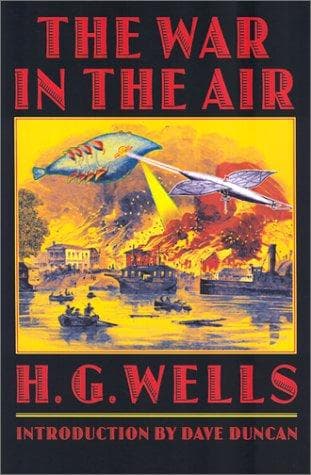
Air warfare -- Fiction; Science fiction; War stories
The naval situation in the North Atlantic at that time was a peculiar
one. The United States was by far the stronger of the two powers upon
the sea, but the bulk of the American fleet was still in the Pacific.
It was in the direction of Asia that war had been most feared, for the
situation between Asiatic and white had become unusually violent
and dangerous, and the Japanese government had shown itself quite
unprecedentedly difficult. The German attack therefore found half the
American strength at Manila, and what was called the Second Fleet strung
out across the Pacific in wireless contact between the Asiatic station
and San Francisco. The North Atlantic squadron was the sole American
force on her eastern shore, it was returning from a friendly visit
to France and Spain, and was pumping oil-fuel from tenders in
mid-Atlantic--for most of its ships were steamships--when the
international situation became acute. It was made up of four battleships
and five armoured cruisers ranking almost with battleships, not one of
which was of a later date than 1913. The Americans had indeed grown so
accustomed to the idea that Great Britain could be trusted to keep the
peace of the Atlantic that a naval attack on the eastern seaboard
found them unprepared even in their imaginations. But long before the
declaration of war--indeed, on Whit Monday--the whole German fleet of
eighteen battleships, with a flotilla of fuel tenders and converted
liners containing stores to be used in support of the air-fleet, had
passed through the straits of Dover and headed boldly for New York. Not
only did these German battleships outnumber the Americans two to one,
but they were more heavily armed and more modern in construction--seven
of them having high explosive engines built of Charlottenburg steel, and
all carrying Charlottenburg steel guns.
The fleets came into contact on Wednesday before any actual declaration
of war. The Americans had strung out in the modern fashion at distances
of thirty miles or so, and were steaming to keep themselves between the
Germans and either the eastern states or Panama; because, vital as it
was to defend the seaboard cities and particularly New York, it was
still more vital to save the canal from any attack that might prevent
the return of the main fleet from the Pacific. No doubt, said Kurt, this
was now making records across that ocean, “unless the Japanese have had
the same idea as the Germans.” It was obviously beyond human possibility
that the American North Atlantic fleet could hope to meet and defeat
the German; but, on the other hand, with luck it might fight a delaying
action and inflict such damage as to greatly weaken the attack upon
the coast defences. Its duty, indeed, was not victory but devotion,
the severest task in the world. Meanwhile the submarine defences of New
York, Panama, and the other more vital points could be put in some sort
of order.
Public-domain text, read in full here on John Shaqi.
Reviews
Reviews
No reviews yet
Be the first to share your thoughts on this work.
Elsewhere in the archive
Join the Discussion
Join the discussion
Sign in to leave a comment or review.
Sign InorCreate an account