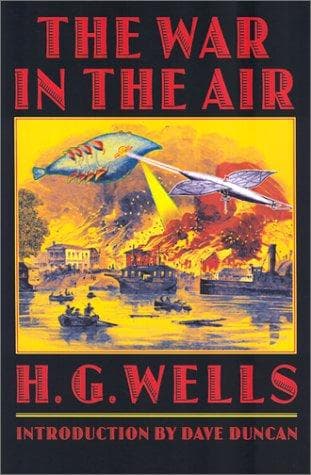
Air warfare -- Fiction; Science fiction; War stories
He craned his neck, but he could not see if the rest of the fleet was
following them; the overhang of the gas-chambers intervened. There
was something that stirred his imagination deeply in that stealthy,
noiseless descent. The obscurity deepened for a time, the last fading
star on the horizon vanished, and he felt the cold presence of cloud.
Then suddenly the glow beneath assumed distinct outlines, became flames,
and the Vaterland ceased to descend and hung observant, and it would
seem unobserved, just beneath a drifting stratum of cloud, a thousand
feet, perhaps, over the battle below.
In the night the struggling naval battle and retreat had entered upon a
new phase. The Americans had drawn together the ends of the flying line
skilfully and dexterously, until at last it was a column and well to the
south of the lax sweeping pursuit of the Germans. Then in the darkness
before the dawn they had come about and steamed northward in close order
with the idea of passing through the German battle-line and falling
upon the flotilla that was making for New York in support of the German
air-fleet. Much had altered since the first contact of the fleets. By
this time the American admiral, O'Connor, was fully informed of the
existence of the airships, and he was no longer vitally concerned for
Panama, since the submarine flotilla was reported arrived there from Key
West, and the Delaware and Abraham Lincoln, two powerful and entirely
modern ships, were already at Rio Grande, on the Pacific side of the
canal. His manoeuvre was, however, delayed by a boiler explosion on
board the Susquehanna, and dawn found this ship in sight of and indeed
so close to the Bremen and Weimar that they instantly engaged. There was
no alternative to her abandonment but a fleet engagement. O'Connor chose
the latter course. It was by no means a hopeless fight. The Germans,
though much more numerous and powerful than the Americans, were in a
dispersed line measuring nearly forty-five miles from end to end, and
there were many chances that before they could gather in for the fight
the column of seven Americans would have ripped them from end to end.
Public-domain text, read in full here on John Shaqi.
Reviews
Reviews
No reviews yet
Be the first to share your thoughts on this work.
Elsewhere in the archive
Join the Discussion
Join the discussion
Sign in to leave a comment or review.
Sign InorCreate an account