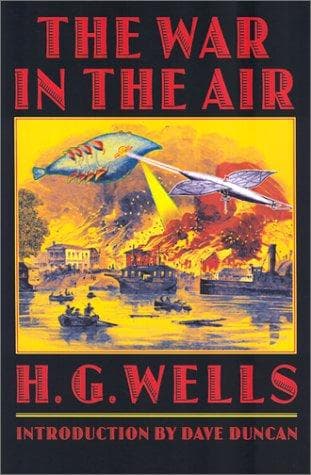
Air warfare -- Fiction; Science fiction; War stories
The City of New York was in the year of the German attack the largest,
richest, in many respects the most splendid, and in some, the wickedest
city the world had ever seen. She was the supreme type of the City of
the Scientific Commercial Age; she displayed its greatness, its power,
its ruthless anarchic enterprise, and its social disorganisation most
strikingly and completely. She had long ousted London from her pride of
place as the modern Babylon, she was the centre of the world's finance,
the world's trade, and the world's pleasure; and men likened her to
the apocalyptic cities of the ancient prophets. She sat drinking up the
wealth of a continent as Rome once drank the wealth of the Mediterranean
and Babylon the wealth of the east. In her streets one found the
extremes of magnificence and misery, of civilisation and disorder. In
one quarter, palaces of marble, laced and crowned with light and flame
and flowers, towered up into her marvellous twilights beautiful, beyond
description; in another, a black and sinister polyglot population
sweltered in indescribable congestion in warrens, and excavations beyond
the power and knowledge of government. Her vice, her crime, her law
alike were inspired by a fierce and terrible energy, and like the great
cities of mediaeval Italy, her ways were dark and adventurous with
private war.
It was the peculiar shape of Manhattan Island, pressed in by arms of the
sea on either side, and incapable of comfortable expansion, except along
a narrow northward belt, that first gave the New York architects their
bias for extreme vertical dimensions. Every need was lavishly supplied
them--money, material, labour; only space was restricted. To begin,
therefore, they built high perforce. But to do so was to discover a
whole new world of architectural beauty, of exquisite ascendant lines,
and long after the central congestion had been relieved by tunnels
under the sea, four colossal bridges over the east river, and a dozen
mono-rail cables east and west, the upward growth went on. In many ways
New York and her gorgeous plutocracy repeated Venice in the magnificence
of her architecture, painting, metal-work and sculpture, for example,
in the grim intensity of her political method, in her maritime and
commercial ascendancy. But she repeated no previous state at all in the
lax disorder of her internal administration, a laxity that made vast
sections of her area lawless beyond precedent, so that it was possible
for whole districts to be impassable, while civil war raged between
street and street, and for Alsatias to exist in her midst in which the
official police never set foot. She was an ethnic whirlpool. The flags
of all nations flew in her harbour, and at the climax, the yearly
coming and going overseas numbered together upwards of two million human
beings. To Europe she was America, to America she was the gateway of
the world. But to tell the story of New York would be to write a social
Public-domain text, read in full here on John Shaqi.
Reviews
Reviews
No reviews yet
Be the first to share your thoughts on this work.
Elsewhere in the archive
Join the Discussion
Join the discussion
Sign in to leave a comment or review.
Sign InorCreate an account