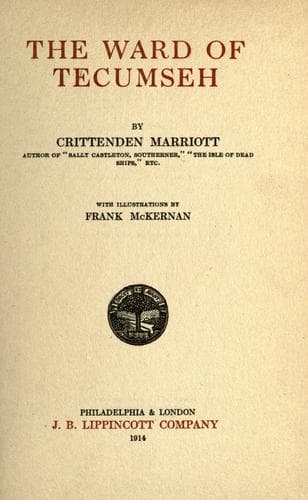
Indians of North America -- Wars -- 1812-1815 -- Fiction; United States -- History -- War of 1812 -- Fiction
Over the sun-drenched fields and through the pleasant woods they held
their way, thrashing through the tall grass, crushing the underbrush
beneath their columned tread. Their slanting flags, whipping in the
rising breeze, revealed the stripes and the soaring stars and flaunted
the regimental symbols. On the right were the regulars of the 25th
infantry, one hundred and twenty strong, grim, well-drilled men who
marched with a precision not found among the volunteers. In the center
and on the left were the Kentucky volunteers, headed by Johnson’s
cavalry, burning to avenge the butchery of their kindred at the River
Raisin. Above them the bayonets flashed back the sunlight.
Steadily they advanced. The distance was still too great for musketry
fire, but it was lessening every instant. The British howitzers, too,
were waiting, masked behind their leafy screen.
A far-off report broke the silence. A mound of white erected itself at
the end of the river road and a howitzer ball hummed along it. Along
the edge of the beech wood ran the crackle of small arms. From the
swamp on the left came the enfilading fire of the Indians. A private
in Desha’s regiment fell forward and lay upon his face, motionless. A
sergeant a hundred feet away doubled up with a grunt.
Steadily the volunteers swung forward to where the westering sun shone
red across the red and yellow carpet that autumn’s winds had strewn.
As they marched they sang, at first low, then with a swing that rose
terribly to the skies:
Scalps are bought at stated prices,
Proctor pays the price in gold.
Freemen, no more bear such slaughters,
Rouse and smite the faithless foe.
Most of the victims of the River Raisin had been Kentuckians; it was
meet and proper that Kentuckians should avenge them at the Thames.
Jack was far in advance of the troops. Familiar with the ground from
his adventure of the night before, he knew where to look for the
enemy’s lines and could venture nearer to them than any other scout. He
had left his horse behind, well out of danger, and had crept forward on
foot, closer and closer, determined to learn in what order the British
designed to meet the attack. Nearer and nearer he crept, flat on the
ground, worming his way. At last, beneath the shadow of the trees he
saw the crossed white on red that marked the British soldiers. Detail
after detail he noted; then, when a bugle at the rear told him that the
Americans were advancing, he began to worm backward.
At his horse at last, he leaped to the saddle and drove the spurs deep,
heading for the spot where the ringing bugle was sounding the advance.
General Harrison, surrounded by his staff, stood watching. “Now’s the
time,” he muttered. “Trumpeter! Sound the----” He broke off, as a scout
came dashing toward him.
It was Jack. “General!” he clamored. “They’re in two lines in open
order.”
Harrison started. “In open order!” he cried. “You’re mad.”
Public-domain text, read in full here on John Shaqi.
Reviews
Reviews
No reviews yet
Be the first to share your thoughts on this work.
Elsewhere in the archive
Join the Discussion
Join the discussion
Sign in to leave a comment or review.
Sign InorCreate an account