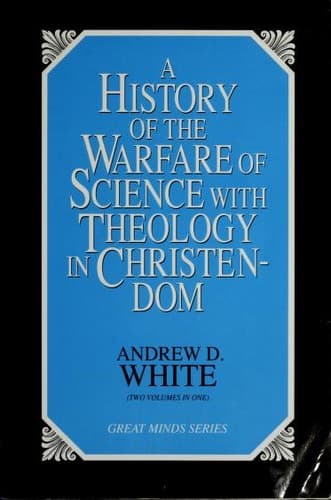
Religion and science; Religion and science -- History; Science -- History
[16] For effect of Magalhaens's voyages, and the reluctance to yield
to proof, see _Henri Martin_, _Histoire de France_, vol. xiv., p. 395;
_St. Martin's Histoire de la Géog._, p. 369; _Peschel_, _Geschichte des
Zeitalters der Entdeckungen_, concluding chapters; and for an admirable
summary, _Draper_, _Hist. Int. Dev. of Europe_, pp. 451-453.
[17] For general statement as to supplementary proof by measurement of
degrees, and by pendulum, see _Somerville_, _Phys. Geog._, chapter i, §
6, note. Also _Humboldt_, _Cosmos_, vol. ii., p. 736, and v., pp. 16,
32. Also _Montucla_, iv., 138.
[18] _Respectability of Geocentric Theory_, _Plato's Authority for it_
etc., see _Grote's Plato_, vol. iii., p. 257. Also, _Sir G. C. Lewis_,
_Astronomy of the Ancients_, chap, iii., sec. i., for a very thoughtful
statement of Plato's view, and differing from ancient statements. For
plausible elaboration of it, see _Fromundus_, _Anti-Aristarchus_,
Antwerp, 1631. Also _Melanchthon_, _Initia Doctrinæ Physicæ_.
[19] For supposed agreement of Scripture with Ptolemaic theory, see
Fromundus, _passim_, Melanchthon, and a host of other writers.
[20] See _St. Thomas Aquinas_, _Liber de Cœlo et Mundo_, sec. xx.
[21] For _Germs of Heliocentric Theory planted long before_, etc.,
see _Sir G. C. Lewis_; also, _Draper_, _Intellectual Development
of Europe_, p. 512; and for a succinct statement of the claims of
Pythagoras, Philolaus, Aristarchus, and Martianus Capella, see _Hœfer_,
_Hist. de l'Astronomie_, 1873, p. 107, _et seq._ For germs among
thinkers of India, see _Whewell_, vol. i., p. 277. Also, _Whitney_,
_Oriental and Linguistic Studies_, New York, 1874; _Essay on the Lunar
Zodiac_, p. 345.
[22] For general statement of De Cusa's work, see _Draper_,
_Intellectual Development of Europe_, p. 512. For skillful use of
De Cusa's view in order to mitigate censure upon the Church for its
treatment of Copernicus's discovery, see an article in the _Catholic
World_ for January, 1869. For a very exact statement, in a spirit of
judicial fairness, see _Whewell_, _History of the Inductive Sciences_,
p. 275 and pp. 379, 380. In the latter, Whewell cites the exact words
of De Cusa in the _De Docta Ignorantia_, and sums up in these words:
"This train of thought might be a preparation for the reception of the
Copernican system; but it is very different from the doctrine that the
sun is the centre of the planetary system." In the previous passage,
Whewell says that De Cusa "propounded the doctrine of the motion of
the earth, more, however, as a paradox than as a reality. We cannot
consider this as any distinct anticipation of a profound and consistent
view of the truth." For Aristotle's views and their elaboration by St.
Thomas Aquinas, see the treatise _De Cœlo et Mundo_. It is curious to
see how even such a biographer of St. Thomas as Archbishop Vaughan
slurs over the angelic doctor's errors. See _Vaughan's Life and Labors
of St. Thomas of Aquin_, pp. 459, 460.
Public-domain text, read in full here on John Shaqi.
Reviews
Reviews
No reviews yet
Be the first to share your thoughts on this work.
Elsewhere in the archive
Join the Discussion
Join the discussion
Sign in to leave a comment or review.
Sign InorCreate an account