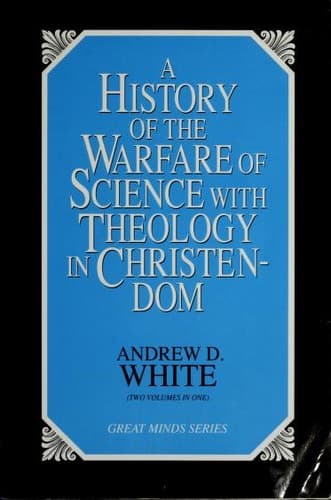
Religion and science; Religion and science -- History; Science -- History
[26] Osiander, in a letter to Copernicus, dated April 20, 1541, had
endeavored to reconcile him to such a procedure, and ends by saying,
"Sic enim placidiores reddideris peripatheticos et theologos quos
contradicturos metuis." See _Apologia Tychonis_ in _Kepleri Opera
Omnia_, Frisch's edition, vol. i., p. 246. Kepler holds Osiander
entirely responsible for this preface. Bertrand, in his _Fondateurs
de l'Astronomie Moderne_, gives its text, and thinks it possible
that Copernicus may have yielded "in pure condescension toward his
disciple." But this idea is utterly at variance with expressions in
Copernicus's own dedicatory letter to the pope, which follows the
preface. For a good summary of the argument, see _Figuier_, _Savants
de la Renaissance_, pp. 378, 379. See, also, citation from Gassendi's
life of Copernicus, in _Flammarion_, _Vie de Copernic_, p. 124. Mr.
John Fiske, accurate as he usually is, in his recent _Outlines of
Cosmic Philosophy_, appears to have followed Laplace, Delambre, and
Petit into the error of supposing that Copernicus, and not Osiander, is
responsible for the preface.
[27] _Figuier_, _Savants de la Renaissance_, p. 380. Also,
_Flammarion_, _Vie de Copernic_, p. 190.
[28] The "proper authorities" in this case were the "Congregation
of the Index," or cardinals having charge of the "Index Librorum
Prohibitorum." Recent desperate attempts to fasten the responsibility
on them as individuals seem ridiculous in view of the simple fact that
their work is sanctioned by the highest Church authority, and required
to be universally accepted by the Church. Three of four editions of the
"Index" in my own possession declare on their title-pages that they are
issued by order of the pontiff of the period, and each is prefaced by
a special papal bull or letter. See, especially, Index of 1664, issued
under order of Alexander VII., and that of 1761, under Benedict XIV.
Copernicus's work was prohibited in the Index "_donec corrigatur_."
Kepler said that it ought to be worded "_donec explicetur_." See
_Bertrand_, _Fondateurs de l'Astronomie Moderne_, p. 57. _De Morgan_,
pp. 57-60, gives the corrections required by the Index of 1620. Their
main aim seems to be to reduce Copernicus to the groveling level of
Osiander, making of his discovery a mere hypothesis; but occasionally
they require a virtual giving up of the whole Copernican doctrine, e.
g., "correction" insisted upon for cap. 8, p. 6. For scholarly account
of the relation of the Prohibitory and Expurgatory Indexes to each
other, see _Mendham_, _Literary Policy of the Church of Rome_.
[29] See Fromundus's book, cited above, _passim_, but especially the
heading of chapter vi., and the argument in chaps, x. and xi. For
interesting reference to one of Fromundus's arguments, showing by a
mixture of mathematics and theology, that the earth is the centre of
the universe, see _Quetelet_, _Histoire des Sciences Mathématiques et
Physiques_, Bruxelles, 1864, p. 170.
Public-domain text, read in full here on John Shaqi.
Reviews
Reviews
No reviews yet
Be the first to share your thoughts on this work.
Elsewhere in the archive
Join the Discussion
Join the discussion
Sign in to leave a comment or review.
Sign InorCreate an account