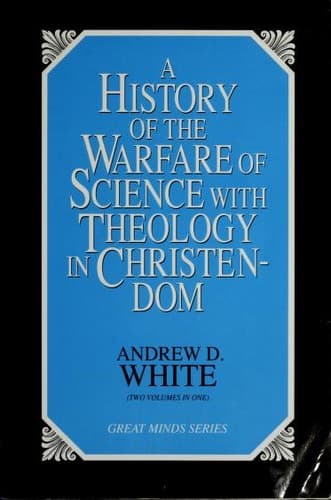
Religion and science; Religion and science -- History; Science -- History
[90] For work of Aquinas, see _St. Thomas Aquinas_, _Liber de Cœlo et
Mundo_, section xx. Also, _Life and Labors of St. Thomas of Aquin_,
by _Archbishop Vaughan_, pp. 459, _et seq._ For his labors in natural
science, see _Hoefer_, _Histoire de la Chimie_, Paris, 1843, vol.
i., p. 381. For theological views of science in middle ages, and
rejoicing thereat, see _Pouchet_, _Hist. des Sci. Nat. au Moyen Age_,
_ubi supra_. Pouchet says: "En général au milieu du moyen âge les
sciences sont essentiellement chrétiennes, leur but est tout-à-fait
religieux, et elles semblent beaucoup moins s'inquiéter de l'avancement
intellectuel de l'homme que de son salut eternel." Pouchet calls this
"conciliation" into a "harmonieux ensemble" "la plus glorieuse des
conquêtes intellectuelles du moyen âge." Pouchet belongs to Rouen, and
the shadow of the Rouen Cathedral seems thrown over all his history.
See, also, _L'Abbé Rohrbacher_, _Hist. de l'Église Catholique_,
Paris, 1858, vol. xviii., pp. 421, _et seq._ The abbé dilates upon
the fact that "the Church organizes the agreement of all the sciences
by the labors of St. Thomas of Aquin and his contemporaries." For
the theological character of science in middle ages, recognized
by a Protestant philosophic historian, see the well-known passage
in _Guizot_, _History of Civilization in Europe_; and by a noted
Protestant ecclesiastic, see _Bishop Hampden's Life of Thomas Aquinas_,
chaps. xxxvi., xxxvii. See, also, _Hallam_, _Middle Ages_, chap. ix.
For dealings of Pope John XXII., and kings of France and England, and
republic of Venice, see _Figuier_, _L'Alchimie et les Alchimistes_, pp.
140, 141, where, in a note, the text of the bull _Spondent Pariter_ is
given.
[91] The _Novum Organon_, translated by the Rev. G. W. Kitchin, Oxford,
1855, chap. lxv.
[92] _Novum Organon_, chap. lxxxix.
[93] _Novum Organon_, chap. xciii.
[94] _Bacon, The Advancement of Learning_, edited by W. Aldis Wright,
London, 1873, pp. 47, 48.
[95] For a very contemptuous statement of Lord Bacon's claim to his
position as a philosopher, see _Lange_, _Geschichte des Materialismus_,
Leipsic, 1874, vol. i., p. 219. For a more just statement, see
_Brewster_, _Life of Sir Isaac Newton_. See, also, _Jevons_,
_Principles of Science_, London, 1874, vol. ii., p. 298.
[96] Kopp, in his _Ansichten_, pushes criticism even to some skepticism
as to Roger Bacon being the _discoverer_ of many of the things
generally attributed to him; but, after all deductions are carefully
made, enough remains to make Bacon the greatest benefactor to humanity
during the middle ages.
[97] For an account of Bacon's treatise, _De Nullitate Magiæ_, see
_Hoefer_.
Public-domain text, read in full here on John Shaqi.
Reviews
Reviews
No reviews yet
Be the first to share your thoughts on this work.
Elsewhere in the archive
Join the Discussion
Join the discussion
Sign in to leave a comment or review.
Sign InorCreate an account