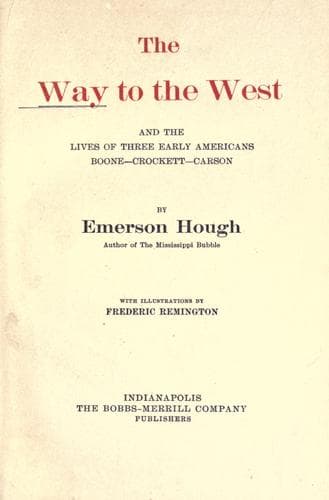
The Way to the West, and the Lives of Three Early Americans: Boone—Crockett—CarsonHough, Emerson
History
The Way to the West, and the Lives of Three Early Americans: Boone—Crockett—Carson
Hough, Emerson
Boone, Daniel, 1734-1820; Carson Kit, 1809-1868; Crockett, Davy, 1786-1836; Mississippi River Valley -- History; West (U.S.) -- History
In reviewing the life of Christopher Carson, another of our Western
leaders in exploration, we come upon the transition period between the
time of up-stream transportation and that which led across the waters;
the epoch wherein fell the closing days of Western adventure properly so
called, and the opening days of a Western civilization fitly so named.
Kit Carson, as he was always called, was born in Madison County,
Kentucky, on December twenty-fourth, 1809. Thus it may be seen that his
time lapped over that of Crockett and even of Boone. It is not generally
known, yet it is the case, that Kit Carson was a grandson of Daniel
Boone.
Carson’s life, therefore, rounds out the time of the great Westerners.
He comes down to the railroad-building day. His was the time of the
long-haired men of the American West. John Colter, Jim Bridger, Bill
Williams, the mulatto Beckwith or Beckworth; the great generals of the
fur trade, Lisa, Ashley, Henry, Smith, Sublette, Fitzpatrick, all that
company of the great captains of hazard—these were the men of his day;
and among them all, not one has come down to us in more distinct figure
or with memory carrying greater respect.
We call Frémont “The Great Pathfinder,” and credit him with the
exploration of the Rockies, the Pacific slope, and the great tramontane
interior basins. Yet Frémont did not begin his explorations until 1842,
and by that time the West of the adventurers was practically an outlived
thing. For ten years the fur trade had been virtually defunct. For more
than a decade the early commerce of the prairies had been waning. The
West had been tramped across from one end to the other by a race of men
peerless in their daring, chief among whom might be named this little,
gentle, blue-eyed man, of whom that genially supercilious and generally
ignorant biographer, J. S. C. Abbott, is good enough to write: “It is
strange that the wilderness could have formed so estimable a character!”
This little man—he is described by one who knew him as a small man, not
over five feet six inches in height—had, long before he ever heard of
Frémont, ridden and walked along every important stream of the Rocky
Mountains; had journeyed across the “American Desert” a dozen times,
back and forth; had seen every foot of the Rockies from the Forks of the
Missouri to the Bayou Salade; had seen all of New Mexico; had visited
old Mexico, Arizona, Nevada, and California as we now know them; had
camped at every resting ground along the Arkansas and Platte; had fought
and traded with every Indian tribe from the Apaches up through the
Navajos, Cheyennes, Comanches, Sioux, and Crows; had even fought the
Blackfeet, redoubtable Northern warriors.
Public-domain text, read in full here on John Shaqi.
Reviews
Reviews
No reviews yet
Be the first to share your thoughts on this work.
Elsewhere in the archive
Join the Discussion
Join the discussion
Sign in to leave a comment or review.
Sign InorCreate an account