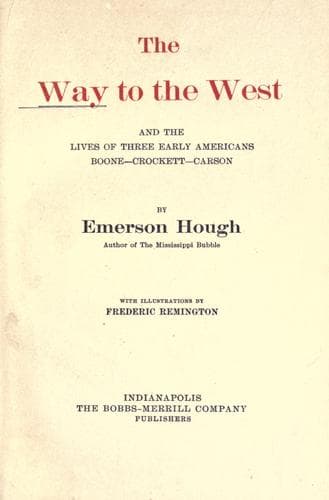
The Way to the West, and the Lives of Three Early Americans: Boone—Crockett—CarsonHough, Emerson
History
The Way to the West, and the Lives of Three Early Americans: Boone—Crockett—Carson
Hough, Emerson
Boone, Daniel, 1734-1820; Carson Kit, 1809-1868; Crockett, Davy, 1786-1836; Mississippi River Valley -- History; West (U.S.) -- History
Carson was now living in a West experiencing sudden and general change.
The old West was nearly gone, and all its ancient ways. The government
at Washington was familiar with the doings of this quiet little man of
New Mexico, and it was suggested that he would make a good Indian agent
for the district of New Mexico. Witness, therefore, the last stage of
Kit Carson’s career, that of counselor and guide to those savage peoples
whose enemy and conqueror he had been.
At this time the Utes and the Jicarilla Apaches were rebellious, and one
of Carson’s first acts was to ride two hundred and fifty miles into the
Ute country. He led the forces that broke up the coalition between the
Utes and the Apaches. It was Carson, old Indian fighter, who was one of
the first to say that the Indians must be “rounded up and taught to till
the soil.” This was his belief even at the time when he acted as guide
for Colonel St. Vrain and his New Mexican volunteers, in the expedition
that routed the Indians at the Saugache Pass.
The Indians that had feared Carson in the past came at length to trust
him, and indeed to love him. He was known as “father” by many a warlike
tribe. Thus he became the friend of the Cheyennes, the Arapahoes and the
Kiowas, peoples scattered over a wide range of country. Behold now,
therefore, our trapper, guide and scout fairly settled in life. Remember
also that he was not the guide of Frémont in that last fatal, starving
expedition when, blundering foolishly once more into the wilderness of
the Rockies in the winter-time, and undertaking the wild project of
crossing eight feet of snow with a pack-train, that officer once more
came near paying the penalty of his ignorance by his own life and the
lives of all his party.
It was Bill Williams who was guide this time, a Bill Williams that had
not been trapping on the Del Norte for years, and who might have been
forgiven memory less keen than had been Carson’s when he saw the two
little peaks, far away in the Coast Range, in that other starving march
of this same leader. It was to Taos that the enfeebled survivors of
Frémont’s disastrous expedition found their way in search of help. If
Kit Carson reproached his former “leader” it is not on record. Never was
there a leader whose follies won him greater praise.
Later in his life, leaving the United States service as Indian agent,
Carson was made colonel of a regiment of New Mexican volunteers, during
the War of the Rebellion. He was brevetted brigadier-general of
volunteers. In the closing years of his life he was known as “the
general” among his friends, just as he was always known as “father”
among the Indians who dwelt about him.
Public-domain text, read in full here on John Shaqi.
Reviews
Reviews
No reviews yet
Be the first to share your thoughts on this work.
Elsewhere in the archive
Join the Discussion
Join the discussion
Sign in to leave a comment or review.
Sign InorCreate an account