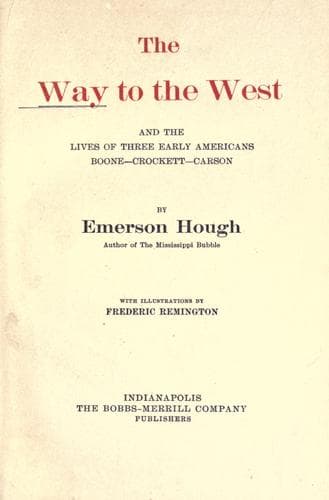
The Way to the West, and the Lives of Three Early Americans: Boone—Crockett—CarsonHough, Emerson
History
The Way to the West, and the Lives of Three Early Americans: Boone—Crockett—Carson
Hough, Emerson
Boone, Daniel, 1734-1820; Carson Kit, 1809-1868; Crockett, Davy, 1786-1836; Mississippi River Valley -- History; West (U.S.) -- History
And fifty per cent. of them are illiterate! Shall we let them come?
Shall we perhaps teach them to eat rice with the rest of us? Shall we
divide our inheritance with them? Shall we remember only that each of
them has a vote? The leveling methods of the Age of Transportation, the
day of the iron trails, have made possible, and have made imperative,
these very questions. Their answer lies in the future, yet perhaps no
very distant future. There are not lacking those, and they constantly
increase in numbers, who believe that the answer must be the putting up
of the bars against all future immigration except of a closely selected
sort, and preferably that bred upon this continent. America has eaten
overmuch; she may yet assimilate, but she must gorge no more. We can now
rear actual Americans enough to feed the world, and to defeat the world
when the time shall come for the fatal shock of arms, and under a system
of rest and recuperation we may become a united and strong America;
while under the system of the past, and the system that now prevails, we
must presently become a warring and divided, hence a weakening, land.
-----
Footnote 60:
Mr. Paul Morton, of the Santa Fé Railroad.
Footnote 61:
Mr. James J. Hill, of the Great Northern Railroad.
Footnote 62:
Wm. F. Flynn, in “Forest and Stream.”
Footnote 63:
Prof. Benjamin F. Terry, of the University of Chicago.
Footnote 64:
Rev. George C. Lorimer.
Footnote 65:
Since the above lines were written the following editorial comment
appeared in a leading American daily newspaper:
“Almost every nation in the world is sending an increasing number of
immigrants to the United States. Last month (April, 1903) the
new-comers numbered 126,200, being 30,000 more than for April of 1902.
The total for the year may reach 1,000,000, or half the population of
Chicago, the second largest city in the country.
“Is so great an influx of foreigners natural or desirable? Many in a
condition to know say that immigration is promoted largely by
mine-owners and railroad managers, who wish to be kept supplied with
cheap labor, and who do not care particularly whence it comes or
whether it will be desirable material out of which to make American
citizens, or whether its presence may not contribute to social or
industrial disorder.
“Many of the great railroad systems approve of unrestricted
immigration because it swells their profitable emigrant business. They
have their agents in Europe soliciting that kind of business. The
greater the number of men and women that can be induced to come to
this country and to buy tickets to interior points, the more money the
roads make. They offer low ocean and rail rates, which tempt the
emigrant and yet are profitable to the roads.
Public-domain text, read in full here on John Shaqi.
Reviews
Reviews
No reviews yet
Be the first to share your thoughts on this work.
Elsewhere in the archive
Join the Discussion
Join the discussion
Sign in to leave a comment or review.
Sign InorCreate an account