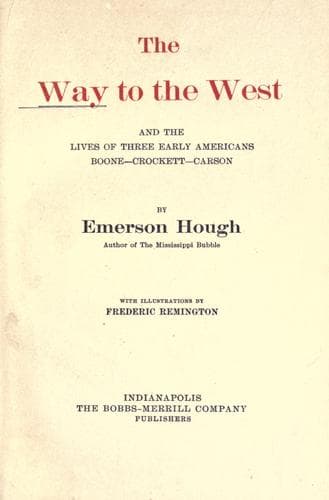
The Way to the West, and the Lives of Three Early Americans: Boone—Crockett—CarsonHough, Emerson
History
The Way to the West, and the Lives of Three Early Americans: Boone—Crockett—Carson
Hough, Emerson
Boone, Daniel, 1734-1820; Carson Kit, 1809-1868; Crockett, Davy, 1786-1836; Mississippi River Valley -- History; West (U.S.) -- History
The common carriers, therefore, tell us that our West is now beyond the
Pacific; that the East has come into the West; that the Old World has
come into the New; that the Latin methods of farming must supplant the
Anglo-Saxon ways. Perhaps; but this will take some time. As against the
likelihood of any early and sweeping national action in the matter,
there remains chiefly the vis inertiæ of mental habit in the American
farmer, who hitherto has not been acquainted with the doctrine of
irrigation and reclamation. Vast tracts of California, Colorado, New
Mexico, Arizona, Texas—large regions in what was once considered the
irreclaimable desert of America, go to show that the Western-American
can learn irrigation and can successfully carry on farming of that
nature; but none the less, for the average American farmer, who has been
accustomed to the wide-handed methods of his forefathers, this
proposition will carry no immediate appeal.
The proof of this latter statement lies in that very emigration into
Canada to which attention has been called, and which constitutes one of
the most remarkable phenomena ever known in the history of the American
West. These dwellers under the Stars and Stripes, these citizens of the
land of the free, of the land supposed to offer the greatest extent of
human opportunity to-day, are flocking across her borders with the
purpose of establishing homes in an alien land, and under a flag from
which in a century gone by they made deliberate and forcible desertion!
They want the cheap lands, the wide acres, the great horizon of a West,
even if they must find that West in land other than that which bore
them! They do not want irrigated land that is worth one hundred dollars
an acre, even though there be an unchanging and pleasant climate as an
attraction thereto. They prefer a cold, bleak environment, a rude, hard
life, with poorer markets, a looser touch with civilization, but with a
bolder, a wider and freer individual horizon. There has been nothing in
our history more pathetic than this. There has been nothing more
cheerlessly disheartening in our history than the thought that we are
exchanging thousands of men of this bold and rugged type, men who are
willing and able to go out into the savage wilderness and lay it under
tribute, for an equal number of thousands of shiftless and unambitious
incoming population, who are willing to live on the droppings of the
American table.
Public-domain text, read in full here on John Shaqi.
Reviews
Reviews
No reviews yet
Be the first to share your thoughts on this work.
Elsewhere in the archive
Join the Discussion
Join the discussion
Sign in to leave a comment or review.
Sign InorCreate an account