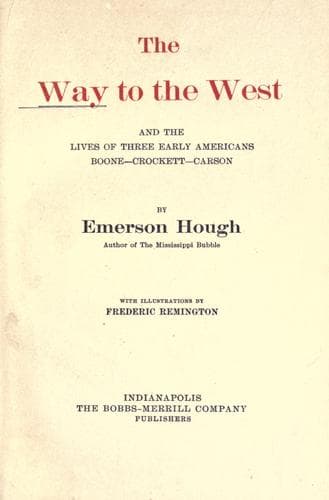
The Way to the West, and the Lives of Three Early Americans: Boone—Crockett—CarsonHough, Emerson
History
The Way to the West, and the Lives of Three Early Americans: Boone—Crockett—Carson
Hough, Emerson
Boone, Daniel, 1734-1820; Carson Kit, 1809-1868; Crockett, Davy, 1786-1836; Mississippi River Valley -- History; West (U.S.) -- History
“Col. George Morgan embarked at the village of Kaskaskia, on the
Kaskaskia River, for his voyage down the Mississippi on the 21st of
November, 1766. Butler, in his history of Kentucky, gives the credit
of being the first American citizen to descend the Mississippi to Col.
Taylor, in 1769. Col. Morgan was the first American citizen to found a
colony in the Territory of Louisiana. Under a grant of King Carlos IV,
he built the city of New Madrid, March, 1789. The grant embraced some
15,000,000 acres of land. (Gayarré; ‘History of Louisiana.’) On June
20, 1788, Congress ordered the annulment of Col. Morgan’s Indian claim
to a greater portion of the state of Illinois, ‘claiming the land
bordering on the Mississippi, from the mouth of the Ohio to a
determined station on the Mississippi that shall be sixty or eighty
miles north from the mouth of the Illinois River, and extending from
the Mississippi as far eastward as may.’ The treaty meeting held under
the auspices of Sir William Johnson at Fort Stanwix, when the Indians
deeded the territory of Indiana to George Morgan, his father-in-law
John Boynton, and his partner Samuel Wharton, (Boynton, Wharton &
Morgan) and several other minor traders whose goods had been
despoiled, was held on November 3, 1768. The state of Virginia claimed
the territory after the Revolutionary War, and bullied the national
government into compliance with her claims, the United States
accepting the property as a present from Virginia, immediately after
deciding in her favor. (See Journal of Congress, 1784, Feb. 26.)”
CHAPTER VIII
DANIEL BOONE
In preceding chapters we have taken up in general and in particular the
origin, the purpose and the progress of the early American frontiersman.
We have seen how this man, impelled by one reason or another, began to
push outward on his way over the Appalachian range into the valley of
the Mississippi. We have seen that the course of west-bound civilization
was at first not wholly along the easiest way, but over barriers that
had apparently been established by nature as insurmountable.
From headwater to headwater, among these rugged hills, from one valley
into another, ever and ever westward, the early American had won his
way, until he struck the waters running into the lower Gulf by way of
that great highway of the interior floods, the Mississippi River. We
have seen that for a space the early population did not head directly
westward, but dropped down from Pennsylvania into Maryland and Virginia,
and from Maryland and Virginia into the Carolinas.
Public-domain text, read in full here on John Shaqi.
Reviews
Reviews
No reviews yet
Be the first to share your thoughts on this work.
Join the Discussion
Join the discussion
Sign in to leave a comment or review.
Sign InorCreate an account