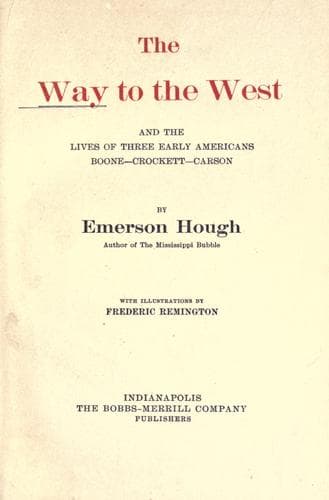
The Way to the West, and the Lives of Three Early Americans: Boone—Crockett—CarsonHough, Emerson
History
The Way to the West, and the Lives of Three Early Americans: Boone—Crockett—Carson
Hough, Emerson
Boone, Daniel, 1734-1820; Carson Kit, 1809-1868; Crockett, Davy, 1786-1836; Mississippi River Valley -- History; West (U.S.) -- History
Many of the early adventurers seem to have made their halting and
rallying ground in North Carolina. Here were some of the men of Watauga,
men who were to people Tennessee, men who were to discover and settle
the grand state of Kentucky, that steadfast portion of our Western
empire whose fidelity was to thwart all of those early efforts at
Western sedition and secession that once threatened the unity of the
American people.
Having thus dealt in generalizations, we shall perhaps now do well to
study some type, some product, of this early civilization, some
character that shall indicate the general characteristics of the land
and people of that early time. In this desire we fall naturally on the
romantic yet pertinent story of that typical and historical
frontiersman, Daniel Boone.
Among the great sayings of great men there is one that rings like a
trumpet voice through all the press of years. “Here stand I,” said
Martin Luther. “Here I stand. I can not otherwise. God help me!” If we
should come to comparisons, we might perhaps call Daniel Boone the
Luther of frontiering, the evangel of adventure, the prophet of early
west-bound daring. Certainly he was the most forward, the most present,
the most instant man of his place and time.
If we endeavor to see Daniel Boone, the man, as he actually was, we find
ourselves at the outset dealing with a character already approaching the
mythical in quality. Thus, in regard to his personality, certain folk
imagine him as tall, thin, angular, uncouth. Others will portray to you
a man with voice like thunder in the hills, with gore ever in his eye,
in his voice perpetually the breathings of insatiate hate and rage. They
will insist that Boone was bloody minded, overbearing, a man delighting
in slaughters and riotings. Such pictures are utterly wrong; so much we
may discover to be absolutely sure from the scant record of Boone’s real
life.
He was Quaker-bred, as we have seen. A sweeter soul than his we shall
not find though we search all the pages of history. Meeting every
species of danger, he remained undaunted. Meeting every manner of
adversity, he remained unsoured. With every reason for conceit, he
remained unbitten of any personal vanity. To the end of his life it was
his belief that he was “an instrument ordained by Providence to settle
the wilderness;” yet he lost no time in posing himself in any
supposititious sainthood. Nor must we imagine him crude or ignorant in
his simplicity, for those who knew him best state that he was “a man of
ambition, shrewdness and energy, as well as of fine social qualities and
an extreme sagacity.”
Public-domain text, read in full here on John Shaqi.
Reviews
Reviews
No reviews yet
Be the first to share your thoughts on this work.
Join the Discussion
Join the discussion
Sign in to leave a comment or review.
Sign InorCreate an account