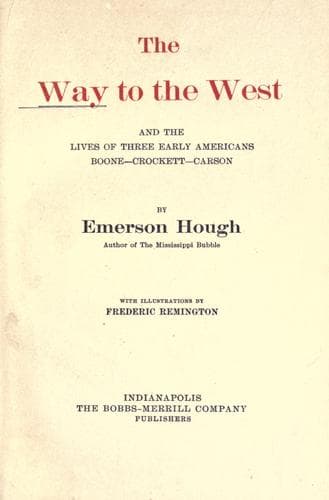
The Way to the West, and the Lives of Three Early Americans: Boone—Crockett—CarsonHough, Emerson
History
The Way to the West, and the Lives of Three Early Americans: Boone—Crockett—Carson
Hough, Emerson
Boone, Daniel, 1734-1820; Carson Kit, 1809-1868; Crockett, Davy, 1786-1836; Mississippi River Valley -- History; West (U.S.) -- History
Previously to his marriage Boone had been a hunter,—what we would now
call a professional hunter. He sometimes took hides and furs to the more
distant Eastern settlements, and so saw some of the Virginia towns. He
was, however, not merely a half-savage woods wanderer, although a past
master in all woodcraft. The year before his marriage he was with the
Pennsylvania militia, who fought the Indians along the border after the
French had defeated George Washington and his Virginians at Great
Meadows. In the fatal Braddock fight Daniel Boone was a wagoner in the
baggage train, and barely escaped with his life in the panic flight.
At twenty-one he was a man grown, matured, acquainted with all the
duties and dangers of frontier life, physically fit for feats of
strength, activity and endurance, and both mentally and physically a
perfect machine for the purposes of vanguard work in the wilderness. His
imagination painted him no gloomy picture of peril, but only scenes of
things delectable a little farther to the west, across the hills that
faced him. His emotions did not prevent his walking forthwith into what
might be peril; and having entered perils, he was content if each day
found him yet alive, nor did his mind entertain forebodings as to the
morrow. The creed of the wilderness, the creed of wild things had
entered into his soul.
They call Daniel Boone explorer, hunter, Indian fighter. Let us figure
him as philosopher. Temperament and training gave footing for that part
of his philosophy that embodied his permanent personal conviction that
“God had appointed him as an instrument for the settlement of the
wilderness.”
Boone, after his marriage, and after his edging out westward toward the
head of the Yadkin, lived much as he had done before. His cabin was no
better than his neighbor’s, his little corn farm was much as theirs,
albeit his table always had wild meat enough and to spare, and there
were hides and furs in abundance. By this time two generations of white
men had held this slope of the Appalachians. The buffalo had in all
likelihood crossed the mountains to the westward, though one writer says
they were “abundant” on the Yadkin at this time. Boone may perhaps have
seen an elk now and then along the Yadkin, but even this is not certain.
Bear, deer, turkey, small furred animals, he took in numbers. He was
content, nor did he differ much from his fellows. He must have been
about thirty years of age before he began to evince traits distinctly
different from those of his scattered wilderness neighbors; before he
began to hear the Voices, whispering yet irresistible, that called him
on; those Voices of the West, which for a hundred years called our best
and boldest to come out into the unknown and the alluring; those Voices
which to-day are perforce stilled forever.
Public-domain text, read in full here on John Shaqi.
Reviews
Reviews
No reviews yet
Be the first to share your thoughts on this work.
Elsewhere in the archive
Join the Discussion
Join the discussion
Sign in to leave a comment or review.
Sign InorCreate an account