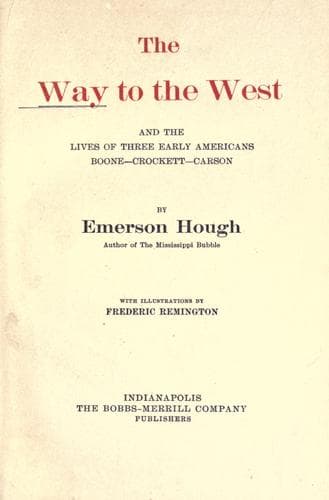
The Way to the West, and the Lives of Three Early Americans: Boone—Crockett—CarsonHough, Emerson
History
The Way to the West, and the Lives of Three Early Americans: Boone—Crockett—Carson
Hough, Emerson
Boone, Daniel, 1734-1820; Carson Kit, 1809-1868; Crockett, Davy, 1786-1836; Mississippi River Valley -- History; West (U.S.) -- History
It was in the year 1769, in the month of May, that Boone started out for
his first determined exploration of “the far-famed but little-known land
of Kentucky.” He had before this time been eager to cross the range and
see for himself; indeed, he had made one short hunting trip into what is
now the eastern edge of the state of Kentucky. Now, in the prime of
life, at thirty-five years of age, he felt that the time had come for
him to cross the range and make his abiding place in the West.
We are accustomed to think that Boone was the first explorer of
Kentucky, but such was by no means the case. Boone’s first trip across
the mountains, to the headwaters of the Holston, was in 1761. John Peter
Salling, a West Virginian, crossed Kentucky and Illinois as early as
1738. Doctor Thomas Walker and a party of Virginians had long before
deliberately explored a part of Kentucky; and in 1751 Boone’s Yadkin
neighbor, Christopher Gist,—the same Gist that accompanied Washington
in his dangerous winter trip to the French forts on the Ohio,—made yet
fuller explorations.
Some of these early voyagings were not made of intent. Salling crossed
Kentucky as a captive of the Indians, who took him as far west as
Kaskaskia; and Mary Draper Ingles, “the first American bride west of the
mountains,” whose father established the first actual settlement west of
the Alleghanies, was in 1755 taken captive by the savages, and carried
across Kentucky and parts of Ohio and Indiana, thus being an explorer
quite against her will.
Two hunters from Pittsburg, James Harrod and Michael Steiner or Stoner,
after pushing out into the Illinois country, crossed the Ohio and
traveled quite across Kentucky, as far south as the present city of
Nashville, Tennessee. Steiner and Harrod were friends of Boone’s, and
Harrod built his stockade of Harrodsburg a year before Boonesborough was
begun, his journey with Steiner having been made two years before Boone
made his pilgrimage across the Divide.
Kasper Mansker or Mansco, later a famous scout and Indian fighter, went
with the Virginian “Long Hunters” into Kentucky in 1769. John Finley or
Finlay had traded with the Indians on the Red River of Kentucky in 1752,
some years before Boone saw that region. Finley was an associate of
Boone’s in the border wars before Boone was married, and it was Finley,
in all likelihood, that first set Boone aflame with the desire to see
and settle in Kentucky. Yet he might have had the counsel of James
McBride, who in 1754 visited the mouth of the Kentucky River, and came
back to say that he “had found the best tract of land in North America,
and probably in the world.” Finley added to these stories, and clinched
it all by saying that game of all kinds was abundant, that the mountains
were beautiful beyond description, and that, moreover, salt could be
manufactured on the spot.
Public-domain text, read in full here on John Shaqi.
Reviews
Reviews
No reviews yet
Be the first to share your thoughts on this work.
Elsewhere in the archive
Join the Discussion
Join the discussion
Sign in to leave a comment or review.
Sign InorCreate an account