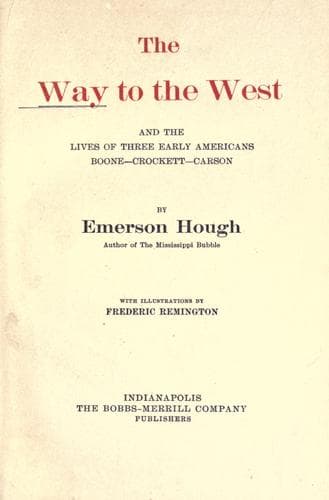
The Way to the West, and the Lives of Three Early Americans: Boone—Crockett—CarsonHough, Emerson
History
The Way to the West, and the Lives of Three Early Americans: Boone—Crockett—Carson
Hough, Emerson
Boone, Daniel, 1734-1820; Carson Kit, 1809-1868; Crockett, Davy, 1786-1836; Mississippi River Valley -- History; West (U.S.) -- History
“Soon after this period,” goes on the simple and businesslike chronicle,
“John Stewart was killed by the Indians.” Hence the two Boone brothers
were left alone, Squire Boone’s companion having met his fate in some
mysterious manner, perhaps at the hands of the Indians, though others
state that he was devoured by wolves,—a very unlikely story. The two
brothers built themselves a rude cabin of poles and bark, and there they
spent the fall and summer of 1769. In May of the following year Squire
Boone returned to North Carolina.[9]
It is now that for the first time we may accord justice to the picture
that shows us the pioneer, Daniel Boone, alone in the wilderness of
Kentucky. He was at this time, so far as he knew, the only white man in
that entire section of country. Fearless, adventurous and self-reliant,
he extended his wanderings farther to the west, and visited the site of
what is now the city of Louisville. His life depended entirely upon his
own vigilance. He was without bread or salt, without even a dog to keep
him company or serve as guard. Naturally he met the savages. Once when
pursued by the Indians, he escaped by the clever artifice of swinging
himself far to one side of his trail by means of a depending
grape-vine—a stratagem not recorded of any other Western adventurer.
He seems to have been happy, alone in a solitude whose nature one can
not understand who has never found himself under conditions at least
mildly similar. His consolation came in his communings with the wild
things about him, in his readings in the great book of nature. His
gallery was the magnificent one of wood and stream and hill. “He stood
upon an eminence, whence, looking about in astonishment, he beheld the
ample plain and beauteous upland, and saw the river rolling in silent
dignity. The chirp of the birds solaced his cares with music. The
numerous deer and elk which passed him gave him assurance that he was in
the midst of plenty. Cheerfulness possessed his mind. He was a second
Adam—if the figure be not too strong—giving names to springs and
rivers and places all unknown to civilized man.” Such was the kingdom of
the West.
Now came again the faithful Squire Boone, all the way from the far-off
Yadkin. These two discovered country of such fertility and such
abundance in game that they no longer had any heart left for the more
barren region of North Carolina. They determined to bring thither their
families, and the fall of that year saw them both back at the old home,
making plans for the pilgrimage into the new world beyond the
Alleghanies. Restless and ill-content we may suppose Daniel to have
been, for it was not until the fall of 1773 that he was able to sell his
farm and get together his effects.
Public-domain text, read in full here on John Shaqi.
Reviews
Reviews
No reviews yet
Be the first to share your thoughts on this work.
Elsewhere in the archive
Join the Discussion
Join the discussion
Sign in to leave a comment or review.
Sign InorCreate an account