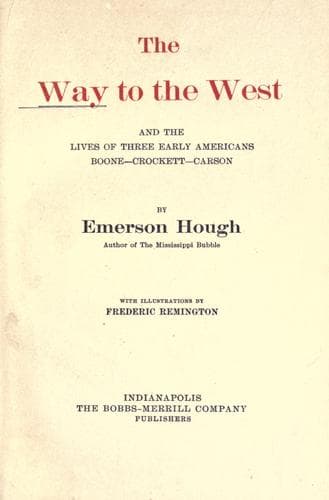
The Way to the West, and the Lives of Three Early Americans: Boone—Crockett—CarsonHough, Emerson
History
The Way to the West, and the Lives of Three Early Americans: Boone—Crockett—Carson
Hough, Emerson
Boone, Daniel, 1734-1820; Carson Kit, 1809-1868; Crockett, Davy, 1786-1836; Mississippi River Valley -- History; West (U.S.) -- History
The birth of a new man in the world, the American, had now taken place.
The Old World explorers took possession with a flag, furled it and
carried it away again. The new man, the American, flung out a flag that
has never yet come down in all the world, and which, please God! never
shall so long as we remain like to the first Americans. John Finley
guided Daniel Boone across the Cumberland Gap; but he guided him into a
land now ready for a Daniel Boone—into a West now ready for the
American man.
It was, then, in the month of May, 1769, that Boone left the Yadkin
settlements and started westward. He had as companions John Finley,
Joseph Holden, James Monay or Mooney, William Coole or Cooley, and John
Stewart or Stuart. Of all the different expeditions into the region west
of the Appalachians this was the most important. Following its doings,
you shall see the long spur of the Anglo-Saxon civilization thrusting
out and out into the West—to the Mississippi, the Missouri, the
Rockies, the Pacific—and never setting backward foot.
The journey over the mountains was not rapid and not continuous, it
being necessary for the party to hunt as well as to explore. The rifle,
the ax, the horse, the boat, were their aids and agents, their argument
and answer to the wilderness. Evolution had gone on. The American was
born.
Boone and his friends seem to have camped on the east side of the
Cumberland Mountains, where they remained for “some days.” It was from
this camp that they made expeditions, and at length climbed to a certain
ridge whence they could see the glorious realm of Kentucky. On this day
they saw their first herd of buffalo, the first trail-makers over the
Appalachians, of which they killed some numbers. They saw, also, elk,
deer and other animals. Boone was delighted. There thrilled in his heart
all the joy of the hunter and explorer. Now the little party moved over
to the Red River, where Finley had formerly been located. “Here,” said
Boone, “both man and beast may grow to their full size.” That was good
American prophecy.
For six months this adventurous little party lived and hunted in their
new empire. Then, swiftly and without warning, there came a taste of
some of the disadvantages of this wild residence. Stewart and Boone were
taken captive by the Indians and were carried to the north, a march of
seven days. On the seventh night they made their escape and came back to
their bivouac on the Red River, only to find that their friends had left
them and returned to the settlements. As offset to this unpleasant news
came their present discovery by Squire Boone and one companion,
Alexander Neeley, who had followed the adventurers all the way into
Kentucky. Daniel’s older brother had brought with him some needful
supplies, chief of these powder and lead, worth far more than gold and
silver.
Public-domain text, read in full here on John Shaqi.
Reviews
Reviews
No reviews yet
Be the first to share your thoughts on this work.
Elsewhere in the archive
Join the Discussion
Join the discussion
Sign in to leave a comment or review.
Sign InorCreate an account