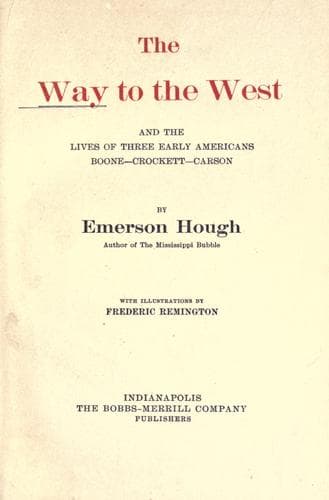
The Way to the West, and the Lives of Three Early Americans: Boone—Crockett—CarsonHough, Emerson
History
The Way to the West, and the Lives of Three Early Americans: Boone—Crockett—Carson
Hough, Emerson
Boone, Daniel, 1734-1820; Carson Kit, 1809-1868; Crockett, Davy, 1786-1836; Mississippi River Valley -- History; West (U.S.) -- History
The civilized necessity for salt was one of the chief causes of danger
for these Kentuckians. In 1778 Boone, with twenty-seven companions, was
engaged in salt-making at the Blue Licks, when they were surrounded by a
large band of Indians. Boone was made captive, with others, and taken
north across the Ohio River. These savages were Shawanese, from the
Pickaway Plain. Eventually they took Boone as far north as Detroit,
where the commandant, Hamilton, pleased with Boone’s manly character,
undertook to ransom him from the savages. The latter, however, would not
hear to this, and after some parleying concluded to make Boone one of
their tribe.
He lived with them for some months, his fate meantime quite unknown to
his friends at Boonesborough. At length, discovering a war party of more
than four hundred savages preparing to invade the Kentucky frontier, he
escaped from his captors, journeyed two hundred miles to the southward,
and saved not only Boonesborough but all the infant posts of this new
commonwealth beyond the Alleghanies. This, were there naught else to
commend him, should establish Boone’s place as one of the great pillars
of the west-bound civilization.
After the savages were at last beaten away in this attack, Boone found
that he was a man not without a country, but without a family. His wife,
supposing him dead, had returned to the old home on the Yadkin. There is
a wide hiatus here in the Boone history, regarding which Boone himself
is reticent.
It is probable that at this time there began those legal difficulties
that later caused the pioneer to leave his chosen land. He had been
given a grant of land by the governor of Virginia, but the state of
Kentucky had never been surveyed, and it was the fashion and privilege
of every holder of one of these loose titles to locate his land as he
pleased, and to record it in the simplest and most primitive fashion.
Thus there came to be many claimants for the best of the lands, the
desirable tracts being sometimes deeply covered by these old-time
“shingle titles.”
The courts swiftly followed into these crude little Kentucky
communities. It may have been the legal complications in which Boone now
found himself that made him unwilling to speak of this period of his
career. It is also known that at one time he was custodian of some
twenty thousand dollars of money, which he intended to take eastward
across the Alleghanies for the purchase of lands. He was robbed, and
hence carried to his grave the bitter sense that he had, through no
fault of his own, been unable to carry out a trust that had been imposed
on him. Yet, be these things as they may, the fact remains that he did
again bring his family to his chosen settlement on the Kentucky River.
Public-domain text, read in full here on John Shaqi.
Reviews
Reviews
No reviews yet
Be the first to share your thoughts on this work.
Elsewhere in the archive
Join the Discussion
Join the discussion
Sign in to leave a comment or review.
Sign InorCreate an account