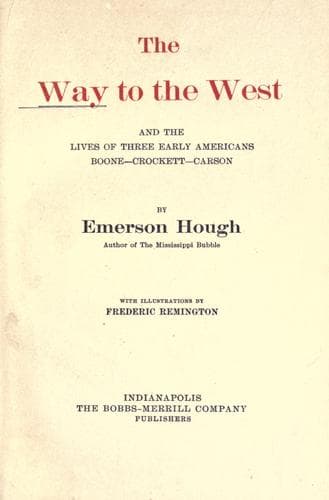
The Way to the West, and the Lives of Three Early Americans: Boone—Crockett—CarsonHough, Emerson
History
The Way to the West, and the Lives of Three Early Americans: Boone—Crockett—Carson
Hough, Emerson
Boone, Daniel, 1734-1820; Carson Kit, 1809-1868; Crockett, Davy, 1786-1836; Mississippi River Valley -- History; West (U.S.) -- History
Meantime the Northern savages, under their own leaders, under the
leadership of British officers, under the leadership of the dangerous
renegades, Girty and McKee, came down time and again on the Kentucky
settlements. The salt parties must go out as before, and in one of these
excursions Squire Boone, Daniel’s beloved older brother, fell a victim
to the savages. In the celebrated and ill-fated McGary fight—the
blackest battle of all Kentucky—a son of Daniel Boone’s fell with the
flower of the frontier. Again and again the tribes came raging down, the
Cherokees, the Pottawatamies, the Shawanese, all joining hands to wipe
these settlements from the face of the earth. In the fight at Bryant’s
Station, little as it was, thirty of the savages were left on the field.
The year 1781 was one of wrath for the thin firing line on the western
side of the Divide. All the fights and the fighters centered about or
came from the “Dark and Bloody Ground.” Clark, Hardin, Harmar—all these
started from Kentucky, and by reason of Kentucky. It was General Scott
with one thousand Kentuckians that avenged the horrible defeat of St.
Clair, killed two hundred of the victorious savages, and took back from
them their booty. In the seven years from 1783 to 1790 there were
fifteen hundred whites killed or taken captive in the state of Kentucky.
In all these affairs, we may be sure, Daniel Boone held his full and
manly part. He had drunk the war-drink of the savages during his
captivity, and the spirit of the savage had entered into him.
Yet Boone was simple and unpretentious as any leader that ever lived.
Once Simon Kenton, himself a hardy soul, set out with some friends on a
little hunt from the station at Boonesborough. They were fired upon by
Indians from ambush. One man was shot down by the Indians within seventy
yards of the stockade. His murderer would have scalped him had not
Kenton dropped him, a corpse beside a corpse. Then it was general mêlée
until Daniel Boone and ten others came out from the stockade to assist
their fighting comrades. Kenton killed another Indian, and then there
came a rush. Boone directed a charge upon the savages, but was shot
down, a ball breaking his leg. Kenton, brave fellow that he was, shot
down Boone’s assailant and carried Boone safely into the fort. As he lay
on the couch receiving attention for the leg broken by the ball, Boone
sent for Kenton and said: “Well, Simon, you have behaved like a man
to-day. Indeed you are a fine fellow.” That was all there was to it.
They made no great parade in those days. There was no proclamation in
the public places. There were no illustrated newspapers, no gifted war
correspondents to describe the heroism of that time. A similar act
to-day would have made both participants famous, would perhaps have won
for both a Victoria Cross, and would have afforded imaginative
correspondents excellent opportunity. The West had no Victoria Crosses,
nor needed any.
Public-domain text, read in full here on John Shaqi.
Reviews
Reviews
No reviews yet
Be the first to share your thoughts on this work.
Elsewhere in the archive
Join the Discussion
Join the discussion
Sign in to leave a comment or review.
Sign InorCreate an account