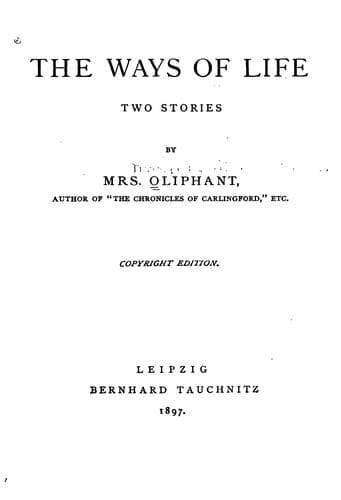
The Ways of Life: Two StoriesOliphant, Mrs. (Margaret)
General
The Ways of Life: Two Stories
Oliphant, Mrs. (Margaret)
Fiction
His idea of honour and probity was perhaps
more abstract than that of a man who was involved in sharp business
transactions, in speculation and commercial adventure, and who was,
besides, a man with a family, bent upon saving them from ruin. He shook
his head and acknowledged to himself that poor Bob was capable of not
having taken that divergence from strict integrity into account. Had he
made up his mind to die for his family he would not have considered the
ease of the insurance companies. The thought of wronging them would have
sat lightly on his soul.
Mr. Wedderburn took from this self-discussion a habit which remained
with him for all the rest of his life, the habit of shaking his head,
slowly, sadly to himself, as it were, as if in the course of some
remark. It was while he questioned, and doubted, and laid things
together, excusing his friend even while he judged him, that this habit
was acquired. It was not a bad habit for a lawyer who was consulted by
his clients on many delicate questions. It gave an air of regretful
decision, of compassion and sympathy, when he had conclusions to
announce that were not pleasant to his clients. And he never lost this
gesture of reflection and compassion, which was as sacred to Bob
Dalyell as his tombstone. It was thus, with many a vexing doubt and
fear, that he mourned the friend of his youth.
The female members of the party were happily exempted from all these
discussions. It does not often happen that the women have the lightest
part to bear in any such calamity. But in this case it was so. Mrs.
Dalyell mourned her husband most sincerely and deeply, forgetting every
little flaw in his character, and gradually elevating him into the
position of a perfect man--the best husband, the kindest father! And the
girls mourned him with torrents of youthful tears, with a conviction
that they never could smile again, never get beyond the blackness of the
first grief, the awful sensation of the catastrophe. But there was
nothing but pure sorrow in their minds. They thought no more of the
insurance companies than the birds in the garden think of the crumbs
miraculously provided for them when snow is on the ground. Neither had
the slightest doubt ever entered their minds as to what they were told
of his death. They knew every detail, laying it up in their hearts. How
he had parted smiling from his friend at the corner of the street, and
gone off to the sands with his buoyant step, in such health and
strength, in such good-will and good-humour with all the world. This was
what the girls said to themselves, trying to picture his last look upon
life. And they hoped it was some unsuspected failure of the heart, which
the doctor said was most likely--a thing which would give no pain, which
would be over in a moment, so that he would never know he was dying, or
have any pang of anxiety for those he was leaving behind. This was how
the girls realised their father’s death: and their mother’s picture of
Public-domain text, read in full here on John Shaqi.
Reviews
Reviews
No reviews yet
Be the first to share your thoughts on this work.
Elsewhere in the archive
Join the Discussion
Join the discussion
Sign in to leave a comment or review.
Sign InorCreate an account