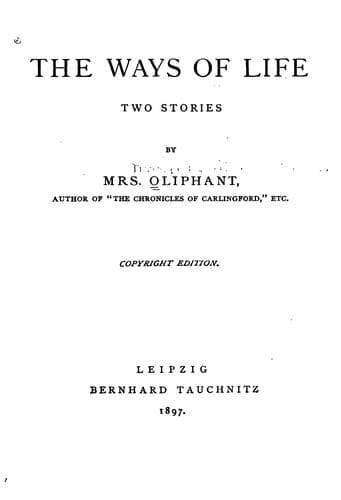
The Ways of Life: Two StoriesOliphant, Mrs. (Margaret)
General
The Ways of Life: Two Stories
Oliphant, Mrs. (Margaret)
Fiction
Even his sudden going home, with the object of frightening his wife out
of a marriage which would have been no marriage, had something of the
character of a jest in it. But there was no longer any jest in the
matter. He had seen his wife, he had seen his son, and he was at last
aware of what it was he had done--the darker aspect of it--the dishonour
to others, the deadly extinction of himself, the end of everything which
he had accomplished, almost with a light heart. A ghost indeed,
offending the eyes and chilling the very soul of those who were most
near and dear to him. “A swindler,” the boy had said. Was he a swindler?
To be sure the insurance offices would never have paid that money had
they known; but surely he had paid the price for it. He had died to all
intents and purposes. He had given himself for his children--a living
sacrifice--not less, but more than if he had really died and been thrown
up by the sea, as everybody believed, on Portobello sands. It is hard to
see guilt in a transaction, not for your own advantage, for which you
have given your life. Robert Dalyell did not blame his son; he could
perceive that there was much in what Fred said, though his heart swelled
in his breast against that injustice. He was not angry with Fred, but
much impressed, and moved (strangely enough) to something like
satisfaction by his son’s demeanour. The boy was a good boy, wounded in
his honour, and therefore inexorable, but only as a good man would wish
his boy to be. He was glad Fred was an honourable fellow, feeling it
like that. Poor Dalyell himself had all the instincts and habits of mind
of an honourable man; he had not seen the dishonour in it; he had
thought that, giving his life for it as he had done, there was nothing
morally wrong in his act. Surely he had bought the money dear: it was
not for him; it was for them, and for their good. There they were, all
of them--the wife who was about to give him a successor within two
years, and the boy who was himself his successor--safe in Yalton,
honoured, respected, enjoying the position to which they were born:
while he was an outcast, without anything but what he made for himself,
and the boy called him a swindler! He was an honest boy for all that,
and Dalyell’s mind had a certain forlorn satisfaction in it: though a
more forlorn being than he, walking, walking like a ghost through that
morning light which began in its pearly paleness to warm to the rising
of the sun, could not be. It was wonderful at what leisure he was, in
the utter forlornness of his being, to think of them all. He was not
sorry that he had given himself to save them. The only thing he was
sorry for was that, being dead, he had interfered at all. He ought to
have gone upon his own way--married, too, as he might have done, and got
himself new ties in his new life. He believed now that there would have
been no harm in that. There would be no harm in it. He would get away as
Public-domain text, read in full here on John Shaqi.
Reviews
Reviews
No reviews yet
Be the first to share your thoughts on this work.
Elsewhere in the archive
Join the Discussion
Join the discussion
Sign in to leave a comment or review.
Sign InorCreate an account