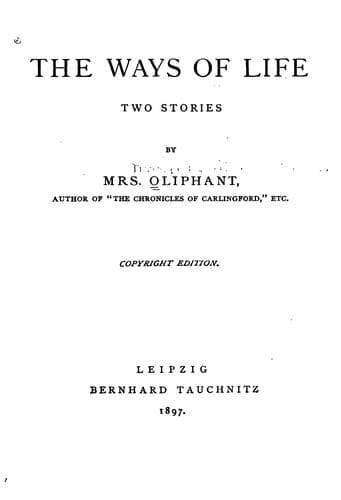
The Ways of Life: Two StoriesOliphant, Mrs. (Margaret)
General
The Ways of Life: Two Stories
Oliphant, Mrs. (Margaret)
Fiction
Mrs. Dalyell put out her soft hand to him over the tea-table with a
smile. There was water in his eyes, though, fortunately, as he stood
with his back to the light, it could not be seen--but there was none in
hers. Her eyes were as serene as the evening skies; and her soft hand,
which perhaps was a little too soft, with no bones in it to speak of,
the hand of a woman never used to do much for herself, met his strong
grasp, in which there was more than many an oath of fidelity, with a
moderate and simple kindness which showed at once how natural and
genuine was the friendship to which she thus pledged her husband, and
how devoid of all tragical elements so far as her comprehension went.
She was a little surprised by Mr. Wedderburn’s grip, which rather hurt
that soft hand, but led the way to the terrace, after he had taken his
tea, with all her usual serenity. She took a shawl from the stand in the
hall and wrapped herself in it as she went out. In Scotland even in July
it is wise to take a shawl when you go out to see the sunset; how much
more in September! Indeed, after she had taken two or three turns upon
the terrace, she went in again, saying that it was all very well for
“you young things” (with a smile at Mr. Wedderburn), but that she knew
what rheumatism was. Susie and Alice were very good company on the
terrace, and they had a thousand things to say to their old friend, so
that, though he had looked occasionally at his watch, he had not taken
very decided note of the passage of time, until an hour after, when Mrs.
Dalyell came back again, with a shawl this time over her head. The sun
had quite gone down, the shadows were lengthening, and twilight stealing
on. “Do you mean to say,” Mrs. Dalyell said as she came down the steps
to the terrace, “that your father’s not here? I made sure he must be
here with you: the train’s been in this half-hour, and there’s not
another till nine--and no telegram. I don’t know what it can mean.”
It could not be said, perhaps, that she was anxious, but she was uneasy,
not knowing what to think. Mr. Wedderburn, for his part, started, as if
the fault had somehow been his. “Bless me!” he said, “I had forgotten
all about it. I might have gone down and met the train.”
“That would have done little good,” said Mrs. Dalyell, “for if he had
come by it he would have been here before now: the thing that astonishes
me is there’s no telegram. Sometimes Robert, like other people, is
detained. Every business man must be detained now and then: but he
always sends a telegram. I never knew him to fail.”
“That is the worst,” said Mr. Wedderburn, “of being too exact in your
ways. If you ever depart from them by any accident everybody thinks
something must have happened.”
Public-domain text, read in full here on John Shaqi.
Reviews
Reviews
No reviews yet
Be the first to share your thoughts on this work.
Elsewhere in the archive
Join the Discussion
Join the discussion
Sign in to leave a comment or review.
Sign InorCreate an account