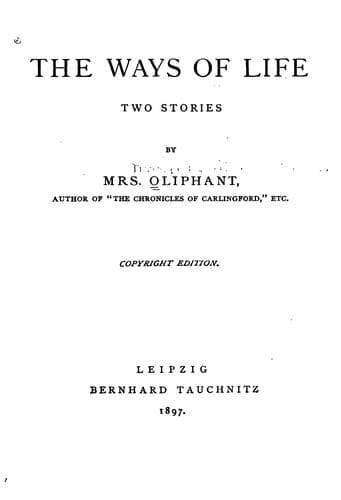
The Ways of Life: Two StoriesOliphant, Mrs. (Margaret)
General
The Ways of Life: Two Stories
Oliphant, Mrs. (Margaret)
Fiction
Mr. Wedderburn went in with very painful fancies, which he could not
shake off. The moment would have come, perhaps, when Bob D’yell had to
tell his family that he was a ruined man, and he would be shrinking from
that stern necessity. His friend pictured him wandering about the dark
streets, or sitting in the rooms above the Insurance Office, where
there was space to receive on occasion a belated director, and counting
up all he had--alas! would it not rather be all the debts he
had--reckoning them, and asking himself how long it would be before the
storm burst, and how he was to tell _her_, and what the poor children
would do? That was what the poor fellow would be thinking, wherever he
was. Instead of coming back--the good lawyer exclaimed within himself in
a little attempt at anger, to keep his sympathy from becoming too
heart-rending--to one that might have helped him! But that would be just
like Bob D’yell--ready enough to come to you if you were in trouble, to
give all his mind to what was to be done: but not if the trouble was his
own: more likely then to hide himself, to think shame of it, as if
misfortune was a man’s own fault. Mr. Wedderburn did not know what to
do, whether to hurry into Edinburgh to make inquiries, or to wait on,
and see whether he would arrive by the late train. Somehow he had very
little faith that his friend would come home. He might go away,
thinking, perhaps, that the creditors would be more gentle with his
family if he were gone. And that would be called absconding! Heaven
only could tell what in his despair the poor fellow might do.
Except suicide: there never occurred to his friend, in the endless
thoughts he had on the subject, any fear of that, which to a Frenchman
would be the first thing to be thought of--the natural refuge for a
bankrupt. No, no!--come what might there was no need to think of that
dark contingency. Besides, Mr. Wedderburn reflected, with a sense of the
grim humour of the suggestion, that Dalyell, as the director of an
insurance company, knew too well that such a step would take away the
last resource his children might have. No, no!--not that. But he might
go away. He might not be able to bear the sight of ruin as affecting
them. That was what chiefly weighed upon himself--the woman and her
children; the girls, who would not know what it meant; and poor Fred,
who would know what it meant--who would have to abandon everything on
which his heart was most set. Had Wedderburn been aware of the
conversation which had taken place between Fred and his father his
troubled thoughts would have been still more serious: as it was, all he
could do was to keep his countenance, to look as like his ordinary as
possible, not to frighten the poor things too soon.
Public-domain text, read in full here on John Shaqi.
Reviews
Reviews
No reviews yet
Be the first to share your thoughts on this work.
Elsewhere in the archive
Join the Discussion
Join the discussion
Sign in to leave a comment or review.
Sign InorCreate an account