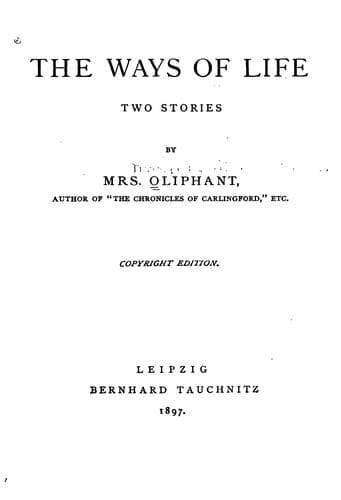
The Ways of Life: Two StoriesOliphant, Mrs. (Margaret)
General
The Ways of Life: Two Stories
Oliphant, Mrs. (Margaret)
Fiction
But there were two of the mourners who were not so simply constituted.
Fred, who had been so light-hearted a boy when his father talked to him
on the terrace and bade him think of the catastrophes which overturned
so many young lives, was greatly changed. He could not get that
conversation out of his mind, nor the strange recommendation his father
had given him, nor the stranger repetition by old Janet of what Mr.
Dalyell had said. How did she know? Had the father confided to her what
was about to happen? Confided?--a thing which was an accident, an
unforeseen calamity, or---- what else? Confided to Janet that next day
he was going to die? Fred turned this over in his mind, over and over,
till he was nearly mad. How did she know? How did she know? Was it
second-sight, witchcraft of one kind or another? But Fred was a young
man of his time--or rather he was not sufficiently a young man of his
time to believe in witchcraft or any occult power. How was it?--how was
it?--how was it? This question went on in his mind so constantly that it
became a sort of mechanical rhyme running through everything. How did
old Janet know? Had it been discovered by her somehow by mystic art? Had
it been confided to her? He could not turn his mind away from this
question or forget it. How did she know?--what did she know? Fred felt
as if he should have informed the commissioners who had investigated the
circumstances of his father’s death of that conversation on the
terrace. It might be only a coincidence; but it was a very curious
coincidence. He ought to have reported it, made it known, that everybody
might draw his own conclusions. Here was a man who as a matter of fact
died by some mysterious accident next day, and who had talked to his son
of what he might have to do were he left with the family on his hands,
and advised whom he should take counsel with in difficulties: and the
proposed counsellor had apparently been communicated with too. What
would the little court of inquiry, he wondered, have said to that? What
would the insurance people have said? Was it his duty to have told the
strange and terrible detail? Was it better to have remained silent? Poor
Fred could not tell what he ought to have done--what he ought to do. He
was but a boy after all, when all was said. He had not been accustomed
to form such momentous decisions for himself, and he was overwhelmed
with grief and misery, not able to think. He remained silent, not
betraying even to Mr. Wedderburn, who was now the guide of the
household, looking after everything, what he felt. But the lad was very
unhappy. There was no reason why he should not return to Oxford; but he
had no desire to return. He did not care to do anything. He wandered
about the grounds asking himself what his father meant, if he had it all
in his mind then as he walked along the terrace in the dark, listening
to his boy’s chatter of college jokes and light-hearted nonsense. Was he
Public-domain text, read in full here on John Shaqi.
Reviews
Reviews
No reviews yet
Be the first to share your thoughts on this work.
Elsewhere in the archive
Join the Discussion
Join the discussion
Sign in to leave a comment or review.
Sign InorCreate an account