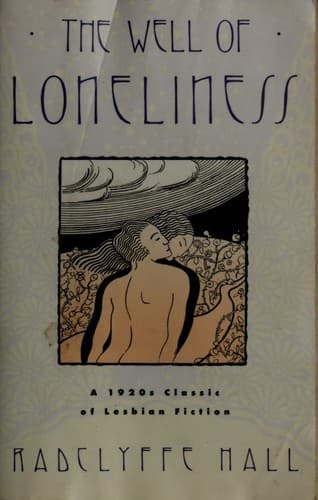
Lesbians -- England -- Social conditions -- Fiction
The Villa Del Ciprés at Orotava was built on a headland above the
Puerto. It had taken its name from its fine cypress trees, of which
there were many in the spacious garden. At the Puerto there were
laughter, shouting and singing as the oxen wagons with their crates of
bananas came grating and stumbling down to the wharf. At the Puerto one
might almost have said there was commerce, for beyond the pier waited
the dirty fruit steamers; but the Villa del Ciprés stood proudly aloof
like a Spanish grandee who had seen better days—one felt that it
literally hated commerce.
The villa was older than the streets of the Puerto, though much grass
grew between their venerable cobbles. It was older than the oldest
villas on the hill, the hill that was known as old Orotava, though their
green latticed shutters were bleached by the suns of innumerable
semi-tropical summers. It was so old indeed, that no peasant could have
told you precisely when it had come into being; the records were lost,
if they had ever existed—for its history one had to apply to its owner.
But then its owner was always in Spain, and his agent who kept the place
in repair, was too lazy to bother himself over trifles. What could it
matter when the first stone was laid, or who laid it? The villa was
always well let—he would yawn, roll a cigarette in his fingers, lick
the paper with the thick, red tip of his tongue, and finally go to sleep
in the sunshine to dream only of satisfactory commissions.
The Villa del Ciprés was a low stone house that had once been tinted a
lemon yellow. Its shutters were greener than those on the hill, for
every ten years or so they were painted. All its principal windows
looked over the sea that lay at the foot of the little headland. There
were large, dim rooms with rough mosaic floors and walls that were
covered by ancient frescoes. Some of these frescoes were primitive but
holy, others were primitive but distinctly less holy; however, they were
all so badly defaced, that the tenants were spared what might otherwise
have been rather a shock at the contrast. The furniture, although very
good of its kind, was sombre, and moreover it was terribly scanty, for
its owner was far too busy in Seville to attend to his villa in Orotava.
But one glory the old house did certainly possess; its garden, a
veritable Eden of a garden, obsessed by a kind of primitive urge towards
all manner of procreation. It was hot with sunshine and the flowing of
sap, so that even its shade held a warmth in its greenness, while the
virile growth of its flowers and its trees gave off a strangely
disturbing fragrance. These trees had long been a haven for birds, from
the crested hoopoes to the wild canaries who kept up a chorus of song in
the branches.
2
Public-domain text, read in full here on John Shaqi.
Reviews
Reviews
No reviews yet
Be the first to share your thoughts on this work.
Elsewhere in the archive
Join the Discussion
Join the discussion
Sign in to leave a comment or review.
Sign InorCreate an account