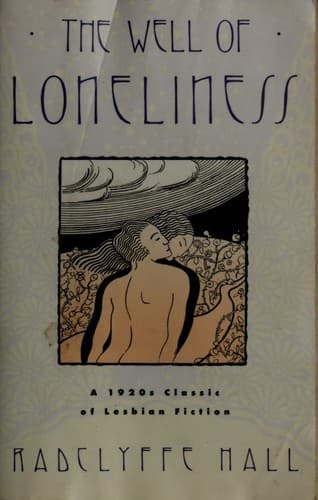
Lesbians -- England -- Social conditions -- Fiction
Very splendid it seemed to her now to have money, because of what money
could do for Mary; in the shops they must sometimes behave like two
children, having endless things dragged out for inspection. They drove
to Versailles in the new touring car and wandered for hours through the
lovely gardens. The Hameau no longer seemed sad to Stephen, for Mary and
she brought love back to the Hameau. Then they drove to the forest of
Fontainebleau, and wherever they went there was singing of
birds—challenging, jubilant, provocative singing: ‘Look at us, look at
us! We’re happy, Stephen!’ And Stephen’s heart shouted back: ‘So are we.
Look at us, look at us, look at us! We’re happy!’
When they were not driving into the country, or amusing themselves by
ransacking Paris, Stephen would fence, to keep herself fit—would fence
as never before with Buisson, so that Buisson would sometimes say with a
grin:
‘Mais voyons, voyons! I have done you no wrong, yet it almost appears
that you wish to kill me!’
The foils laid aside, he might turn to Mary, still grinning: ‘She fence
very well, eh, your friend? She lunge like a man, so strong and so
graceful.’ Which considering all things was generous of Buisson.
But suddenly Buisson would grow very angry: ‘More than seventy francs
have I paid to my cook and for nothing! Bon Dieu! Is this winning the
war? We starve, we go short of our butter and chickens, and before it is
better it is surely much worse. We are all imbeciles, we kind-hearted
French; we starve ourselves to fatten the Germans. Are they grateful?
Sacré Nom! Mais oui, they are grateful—they love us so much that they
spit in our faces!’ And quite often this mood would be vented on
Stephen.
To Mary, however, he was usually polite: ‘You like our Paris? I am
glad—that is good. You make the home with Mademoiselle Gordon; I hope
you prevent her injurious smoking.’
And in spite of his outbursts Mary adored him, because of his interest
in Stephen’s fencing.
2
One evening towards the end of June, Jonathan Brockett walked in
serenely: ‘Hallo, Stephen! Here I am, I’ve turned up again—not that I
love you, I positively hate you. I’ve been keeping away for weeks and
weeks. Why did you never answer my letters? Not so much as a line on a
picture postcard! There’s something in this more than meets the eye. And
where’s Puddle? She used to be kind to me once—I shall lay my head down
on her bosom and weep. . . .’ He stopped abruptly, seeing Mary
Llewellyn, who got up from her deep arm-chair in the corner.
Stephen said: ‘Mary, this is Jonathan Brockett—an old friend of mine;
we’re fellow writers. Brockett, this is Mary Llewellyn.’
Brockett shot a swift glance in Stephen’s direction, then he bowed and
gravely shook hands with Mary.
Public-domain text, read in full here on John Shaqi.
Reviews
Reviews
No reviews yet
Be the first to share your thoughts on this work.
Elsewhere in the archive
Join the Discussion
Join the discussion
Sign in to leave a comment or review.
Sign InorCreate an account